mcdonnell-douglas-dc-9-10

service

McDonnell Douglas DC-9-10 Cargo Specifications and Charter Rates

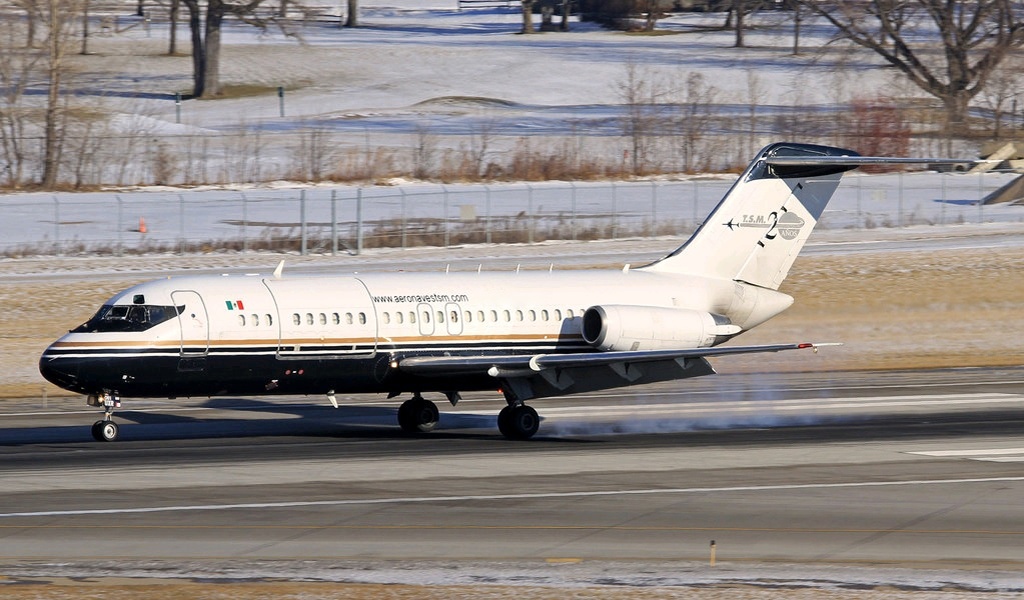
The McDonnell Douglas DC-9-10 is a twin-engine narrow-body jet designed for efficient short to medium-haul cargo operations. With a cruise speed of 485 mph and a maximum range of roughly 2,340 miles, this enduring classic delivers reliable, rapid logistics solutions for time-sensitive freight across a continent. First introduced in the mid-1960s, the DC-9-10 established an industry benchmark for robust engineering, ease of operation, and versatility, ensuring its continued use in modern cargo fleets.


Ideal for operators who require swift turnaround and access to airports with shorter runways, the DC-9-10 is a proven choice for commercial logistics, high-value shipments, and urgent freight. This profile details its operational specifications, cargo hold capacity, typical performance, and why the DC-9-10 remains a backbone of express cargo fleets worldwide.

jettly
service

McDonnell Douglas DC-9-10 Overview

The McDonnell Douglas DC-9-10 stands at the forefront of the cargo jet category, offering a powerful combination of payload capacity, range, and operational flexibility. The aircraft’s streamlined fuselage and high-mounted engines allow for efficient ground handling and rapid loading, while its short-field performance opens up a broader selection of airports for cargo delivery. Its robust Pratt & Whitney JT8D engines enable a service ceiling ideal for weather avoidance and efficient routing.


What distinguishes the DC-9-10 in the competitive cargo sector is its adaptability. The platform can be configured for a range of freight needs, from express parcel shipments to bulk and palletized cargo, meeting the demands of time-critical industries. The DC-9-10’s reliability and proven track record make it a trusted partner for operators who value consistent performance and operational economy.


Decades after its debut, the DC-9-10 continues to serve as a workhorse in commercial cargo fleets, prized for its low operating costs, dependable systems, and the extensive support network that keeps parts and maintenance readily available. For logistics companies seeking a cost-efficient, high-utility aircraft for regional and intercity freight, the DC-9-10 is a compelling solution.

jettly

McDonnell Douglas DC-9-10 Specifications

The figures below summarize the performance and dimensions that matter most when you are matching an aircraft to a trip. They reflect typical configurations; exact numbers vary with weight, weather, and how a given aircraft is equipped.

Aircraft class:

Cargo

Passenger capacity:

Up to (typical), maximum

Crew:

2 pilots, 2 loadmasters

Range:

Approximately 2340 nautical miles (around 2692 statute miles)

High-speed cruise:

422 knots (about 485 mph)

Long-range cruise:

Approximately 400 knots

Service ceiling:

35000 fee

Engines:

Two Pratt & Whitney JT8D-7 turbofans

Thrust:

Roughly 14000 lbf per engine

Takeoff distance:

About 6000 feet

Landing distance:

About 5200 feet

Average fuel burn:

Around 800 gallons per hour

Baggage capacity:

Approximately 0 cubic feet

First delivered:

Mid-1960s

mcdonnell-douglas-dc-9-10

The figures below summarize the performance and dimensions that matter most when you are matching an aircraft to a trip. They reflect typical configurations; exact numbers vary with weight, weather, and how a given aircraft is equipped.

mcdonnell-douglas-dc-9-10

McDonnell Douglas DC-9-10 Range and Performance

With a maximum range of approximately 2,340 nautical miles, the DC-9-10 efficiently links major cargo hubs and regional destinations without the need for a fuel stop. This makes it an outstanding choice for moving freight between cities such as Dallas and Seattle, Atlanta and Los Angeles, or London and Madrid in a single sortie, with ample reserves for alternate routing. | The DC-9-10’s 422-knot high-speed cruise ensures timely delivery, while its 6,000-foot takeoff roll and 5,200-foot landing roll allow access to regional airports and secondary logistics centers. It easily outpaces most turboprops, providing rapid ground-to-ground turnaround for urgent cargo shipments. The aircraft’s robust systems and proven engines guarantee reliable performance in demanding operational environments. | For logistics providers, the DC-9-10’s operational envelope translates to consistent, on-schedule deliveries that maximize the value of every flight hour, outperforming slower or less versatile cargo platforms in the same class.
mcdonnell-douglas-dc-9-10

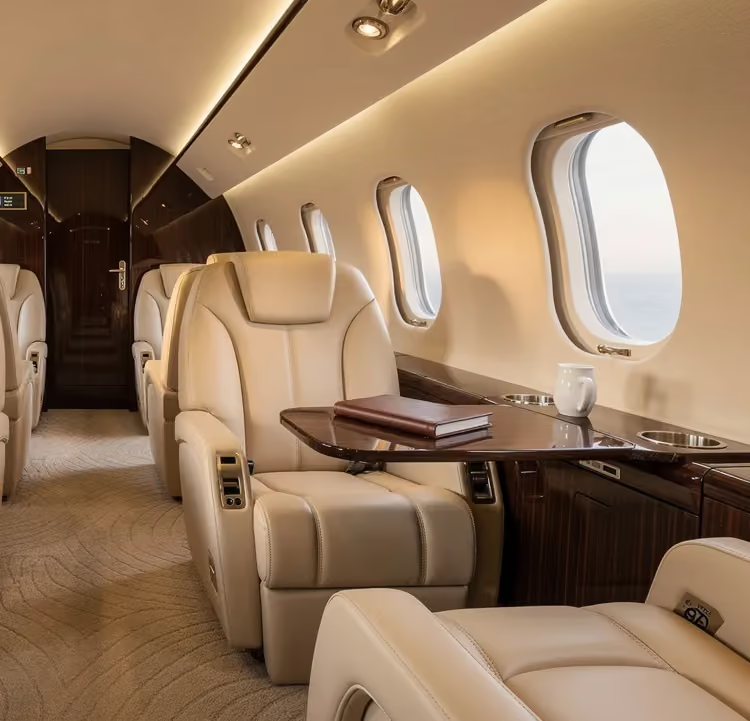
McDonnell Douglas DC-9-10 Cabin Experience and Interior

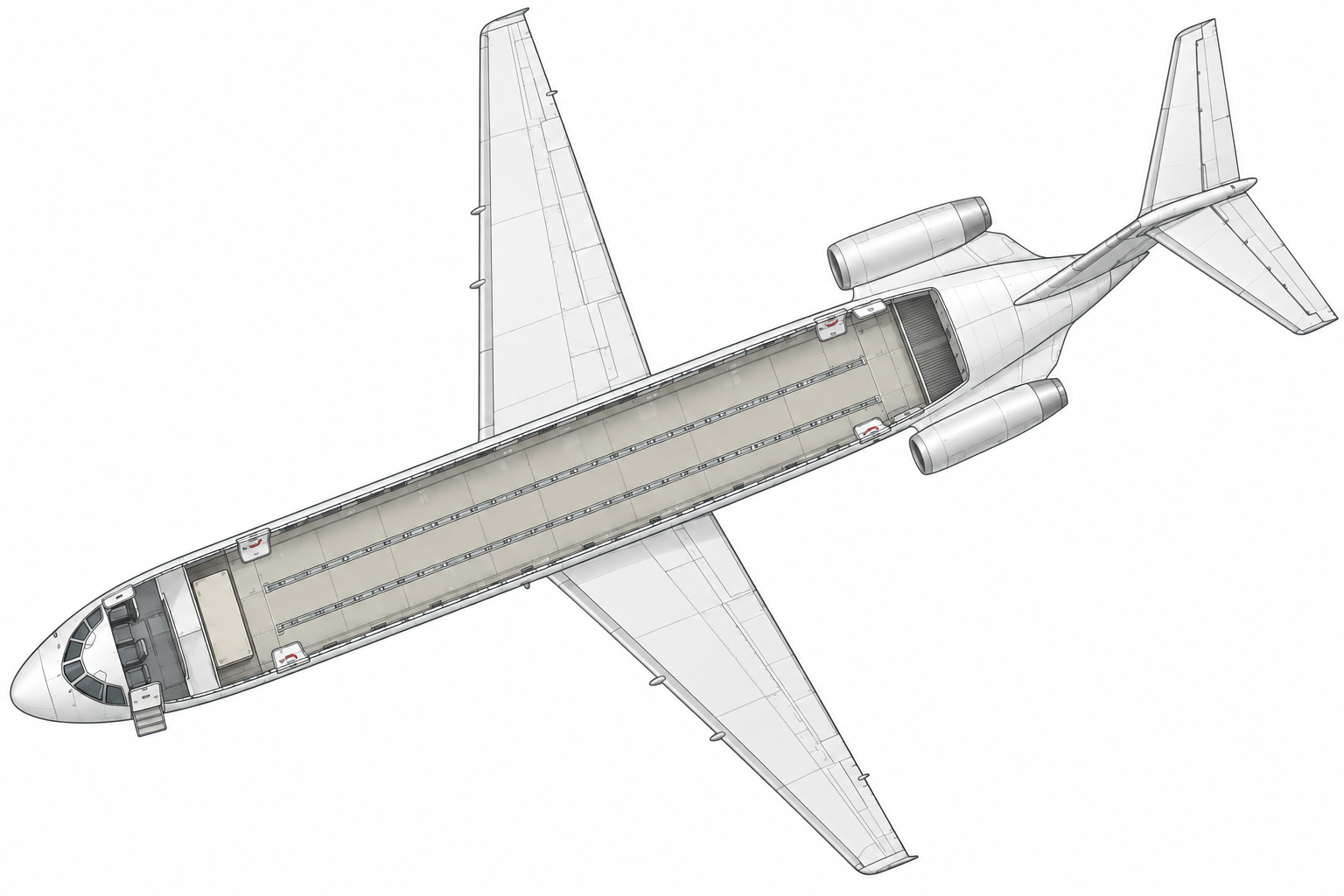
The DC-9-10’s cargo-configured interior is designed for efficiency and adaptability. Its wide fuselage accommodates industry-standard ULDs, pallets, and bulk freight, allowing operators to maximize payload for a wide range of missions. | The main deck features reinforced flooring and a large, hydraulically actuated cargo door, ensuring fast loading and unloading even with heavy shipments. The cabin is engineered for safety, with integrated smoke detection and fire suppression, while ergonomic crew stations and climate control keep loadmasters comfortable during operations. | With its flat floor and unobstructed cargo hold, the DC-9-10 can efficiently carry everything from express parcels and medical supplies to automotive parts and high-value goods, delivering the flexibility and reliability logistics clients demand.

McDonnell Douglas DC-9-10 Charter Cost and Hourly Rates

laptop
A black and white image of an airplane.

Chartering a McDonnell Douglas DC-9-10 typically runs in the range of $5000 to $6500 per flight hour, though the figure you are quoted depends on several factors. Rates move with the route, the season, repositioning (or ferry) time, airport fees, crew costs, and how a specific aircraft is equipped. Peak travel periods and one-way trips that leave an aircraft far from its base tend to sit at the higher end, while round trips and flights that align with an operator's existing schedule can come in lower.

A black and white image of an airplane.

It also helps to understand how charter pricing is structured. Most quotes are built around occupied flight hours plus those repositioning costs, landing and handling fees, taxes, and crew expenses. Because Jettly is a charter marketplace rather than an aircraft operator, you can compare live quotes from multiple FAA Part 121 and book the option that fits your route and budget.

A black and white image of an airplane.

Empty-leg flights, the discounted repositioning trips that operators are keen to fill, can also bring the cost of a McDonnell Douglas DC-9-10 down significantly when the timing works in your favor. For an exact, current price on your specific trip, request a quote, and you will see real availability rather than an estimate.

Who Should Charter the McDonnell Douglas DC-9-10?

The McDonnell Douglas DC-9-10 fits a wide set of missions, which is part of why it stays busy. It is a strong match for:

icon

Small executive teams traveling together to a meeting, site visit, or conference

icon

Regional and many transcontinental business trips that need to be completed in a single day

icon

Families or groups of up to eight heading to a vacation or event

icon

Travelers carrying bulkier baggage, such as golf clubs or ski gear

icon

Anyone who values flexible airport access and a stand-up cabin over the lowest possible price

While the DC-9-10 is not intended for intercontinental or ultra-long-haul operations, it excels in short- and medium-range cargo routes where speed, dependability, and payload are paramount. For freight forwarders and businesses with urgent shipments or specialized cargo needs, the DC-9-10 offers a compelling balance of performance and value.

service

How the McDonnell Douglas DC-9-10 Compares to Other Cargo

The McDonnell Douglas DC-9-10 launched in the mid-1960s, quickly earning a reputation for robust construction and reliability in both passenger and cargo service. Built to meet the rigorous demands of regional airlines, its proven airframe soon became a favorite for freight conversions, supporting the rapid growth of air cargo logistics.


Key innovations included its high-mounted engines and low-set wings, which simplified ground service and allowed operation from airports with limited infrastructure. The DC-9-10’s success spawned a full family of DC-9 variants, each building on the strengths of the original, with thousands produced for operators worldwide.


Today, the DC-9-10 continues to serve on cargo routes thanks to its adaptability and the deep support network built over decades of reliable service. Its enduring legacy is a testament to its smart engineering and the critical role it continues to play in global logistics.

jettly

McDonnell Douglas DC-9-10 History and Background

The McDonnell Douglas DC-9-10 launched in the mid-1960s, quickly earning a reputation for robust construction and reliability in both passenger and cargo service. Built to meet the rigorous demands of regional airlines, its proven airframe soon became a favorite for freight conversions, supporting the rapid growth of air cargo logistics.


Key innovations included its high-mounted engines and low-set wings, which simplified ground service and allowed operation from airports with limited infrastructure. The DC-9-10’s success spawned a full family of DC-9 variants, each building on the strengths of the original, with thousands produced for operators worldwide.


Today, the DC-9-10 continues to serve on cargo routes thanks to its adaptability and the deep support network built over decades of reliable service. Its enduring legacy is a testament to its smart engineering and the critical role it continues to play in global logistics.

plan

Frequently Asked Questions

How Many Passengers Can the McDonnell Douglas DC-9-10 Carry?

The DC-9-10 is typically operated in a dedicated cargo configuration, with the main deck designed for palletized freight, containers, and oversized shipments. Its internal volume and reinforced floor make it ideal for a wide variety of cargo loads.

What Is the Range of the McDonnell Douglas DC-9-10?

The McDonnell Douglas DC-9-10 has a range of approximately 2340 nautical miles, or roughly 2692 statute miles. That is enough to fly most regional routes and many transcontinental trips nonstop, with the longest coast-to-coast legs occasionally needing a brief fuel stop depending on winds and load.

How Fast Does the McDonnell Douglas DC-9-10 Fly?

Its high-speed cruise is 422 knots (about 485 mph), with a long-range cruise near 400 knots. The aircraft's 35000-foot service ceiling lets it fly above most weather and traffic for a smoother, more direct trip.

How Much Does It Cost to Charter a McDonnell Douglas DC-9-10?

Charter rates generally fall between roughly $5000 and $6500 per flight hour, depending on the route, season, repositioning, and fees. Because Jettly is a marketplace, you can compare live quotes from multiple Part 135 operators and book the best option for your trip; empty-leg flights can lower the cost further.

Does the Hawker McDonnell Douglas DC-9-10 Have a Stand-up Cabin?

Yes. The DC-9-10 features a large cargo door for straightforward loading and unloading, a spacious main deck, and a well-appointed crew area with essential amenities for long duty periods.

Is the McDonnell Douglas DC-9-10 Good for Transcontinental Flights?

On most U.S. transcontinental routes, the DC-9-10 can deliver cargo non-stop, though especially heavy payloads or adverse weather may necessitate a brief technical stop, a familiar scenario in commercial cargo operations.

Jettly gives you access to a global marketplace of more than 23,000 aircraft, including McDonnell Douglas DC-9-10 jets operated by vetted FAA Part 121 Part 135 carriers. Compare live quotes, check real availability, and book with full concierge support, whether you are planning a single regional hop or a recurring travel schedule.

Enter your route and dates to get instant pricing on the McDonnell Douglas DC-9-10, or speak with our team about empty-leg deals and membership options that can bring your cost per trip down even further.

MEMBERSHIPS AND ASSOCIATIONS

partner logo
partner logo
partner logo
partner logo
partner logo
partner logo