


Login
Get Instant Pricing On 23,000+ Aircraft


The CH-47 Chinook is a highly capable heavy-lift helicopter, with a maximum external lift capacity of approximately 26,000 pounds at sea level, which decreases in higher altitudes and temperatures. Its tandem rotor design enhances stability and efficiency, making it suitable for various missions, including military operations, disaster relief, and construction. The Chinook's versatility is further supported by its spacious cabin, triple-hook cargo system, and advanced safety features, ensuring reliable performance even in challenging conditions. While primarily used in specialized operations, understanding its capabilities helps clients assess their needs against available civilian charter options.
Jay Franco Serevilla
Jul 7, 2026
|
5
min read



View all
Charter air freight is increasingly favored by businesses for urgent shipments, offering unmatched speed, flexibility, and control compared to standard shipping options. Companies can choose between full charters, which provide exclusive use of an aircraft, and part charters, which allow sharing capacity for smaller loads. This service is vital across various industries, including automotive and pharmaceuticals, where delays can lead to significant financial losses. By leveraging charter air freight, organizations can ensure timely deliveries, mitigate risks, and maintain competitive supply chains.
Jay Franco Serevilla
Feb 8, 2026
|
5
min read

View all
The Private Jet Villa experience combines luxury private jet travel with exclusive villa stays, exemplified by a unique Boeing 737 villa in Bali. This concept allows travelers to access high-end accommodations through cost-effective empty leg flights, significantly reducing private aviation costs by 70-90%. Guests enjoy unparalleled privacy, bespoke services, and stunning views, making it ideal for affluent travelers seeking unique getaways or milestone celebrations. Platforms like Jettly facilitate seamless booking and coordination of flights and villa stays, enhancing the overall luxury experience.
Jay Franco Serevilla
Feb 7, 2026
|
5
min read

View all
The real value of private aviation is access, not luxury. Commercial airlines serve about 500 U.S. airports, while private aviation reaches more than 5,000, creating a structural advantage for organizations operating outside major hubs. As commercial networks continue to consolidate due to aircraft shortages and rising costs, private aviation expands point-to-point access and reduces hidden time and productivity losses. This widening accessibility gap turns mobility into a strategic and financial asset for businesses with distributed operations.
Jay Franco Serevilla
Jan 22, 2026
|
5
min read

View all
Private aviation’s greatest value isn’t short-hop convenience, but the ability to fly intercontinental routes nonstop. Over decades, range advances—from early jets like the Jetstar to modern aircraft like the Gulfstream G800 and Global 8000—have pushed private jets into true long-haul territory. These ultra-long-range capabilities are driving strong market growth as businesses prioritize time savings and global reach over layovers. While future range gains will be limited by fuel physics, today’s 7,000–8,000 nautical-mile jets already cover nearly all global city pairs.
Jay Franco Serevilla
Jan 22, 2026
|
5
min read
View all
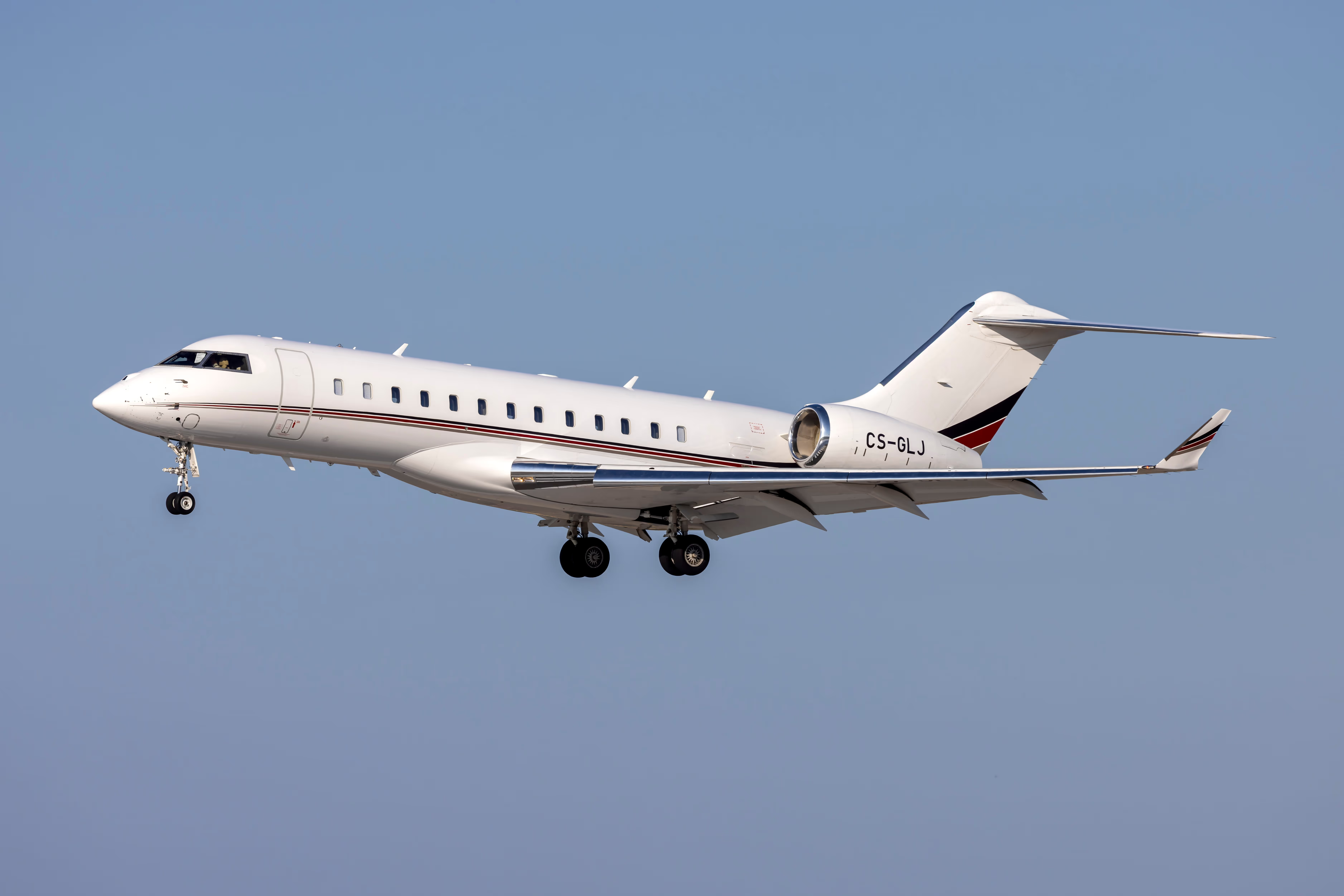
Private aviation programs differ more in structure than in appearance. This page compares Jettly, NetJets, and Flexjet across contracts, capital requirements, flexibility, and exit friction. Traditional fractional ownership was built for long-term commitments and fixed flying patterns. Modern access models are designed for change.
Jay Franco
Jan 13, 2026
|
5
min read

View all
Fractional jet ownership was created when aircraft access was limited and flexibility didn’t exist. Today’s flyers are choosing modern access models that eliminate long-term contracts, idle capital, and fixed-fleet constraints. This page explains why the traditional fractional model is being replaced. Learn how private aviation has evolved.
Jay Franco
Jan 13, 2026
|
5
min read
Explore our latest articles and updates.

5
min read
What Is FAR Part 135? A Clear Guide for Private Charter Travelers
FAR Part 135 is a regulation enforced by the FAA that governs commercial charter operations, ensuring high safety standards for on-demand flights, including air taxis and small commuter services. It requires operators to obtain an Air Carrier Certificate and adhere to strict pilot qualifications, maintenance standards, and operational procedures. Travelers should confirm if their charter flight operates under Part 135, as this impacts safety, pricing, and regulatory oversight compared to Part 91 and Part 121 operations. Jettly connects users with vetted Part 135 operators, facilitating informed booking decisions in private aviation.
Read More
5
min read
How many private pilots are in the US? A 2026 Guide for Aspiring Aviators
As of 2026, there are 174,155 active private pilots in the U.S., part of a total pilot population of 887,519, which includes various certification categories. The number of private pilots has fluctuated over the years, peaking in 1980 and recently stabilizing due to increased demand for flight training and aviation careers. Understanding these statistics is crucial for aspiring aviators and industry stakeholders, as they reflect trends in training costs, medical regulations, and the evolving role of private aviation. Platforms like Jettly facilitate private travel for those without pilot certificates, highlighting the broader participation in private aviation beyond just licensed pilots.
Read MoreJoin our community and receive the latest blog updates directly in your inbox.
MEMBERSHIPS AND ASSOCIATIONS



Disclaimer: Jettly operates as a charter broker, offering access to a global digital jet charter marketplace. Jettly is not a direct air carrier and does not own or operate aircraft. All advertised flights are conducted by third-party air carriers that are fully licensed and hold the appropriate Part 135 or Part 121 certifications issued by the Federal Aviation Administration (FAA) or equivalent regulatory authorities under U.S. or foreign law. Jettly complies fully with the U.S. Department of Transportation's Part 295 and Part 298 Charter Broker regulations. Jettly does not carry additional liability insurance. Passengers are covered by aircraft operator insurance. TICO: 50023770


