



Login
Get Instant Pricing On 23,000+ Aircraft

>
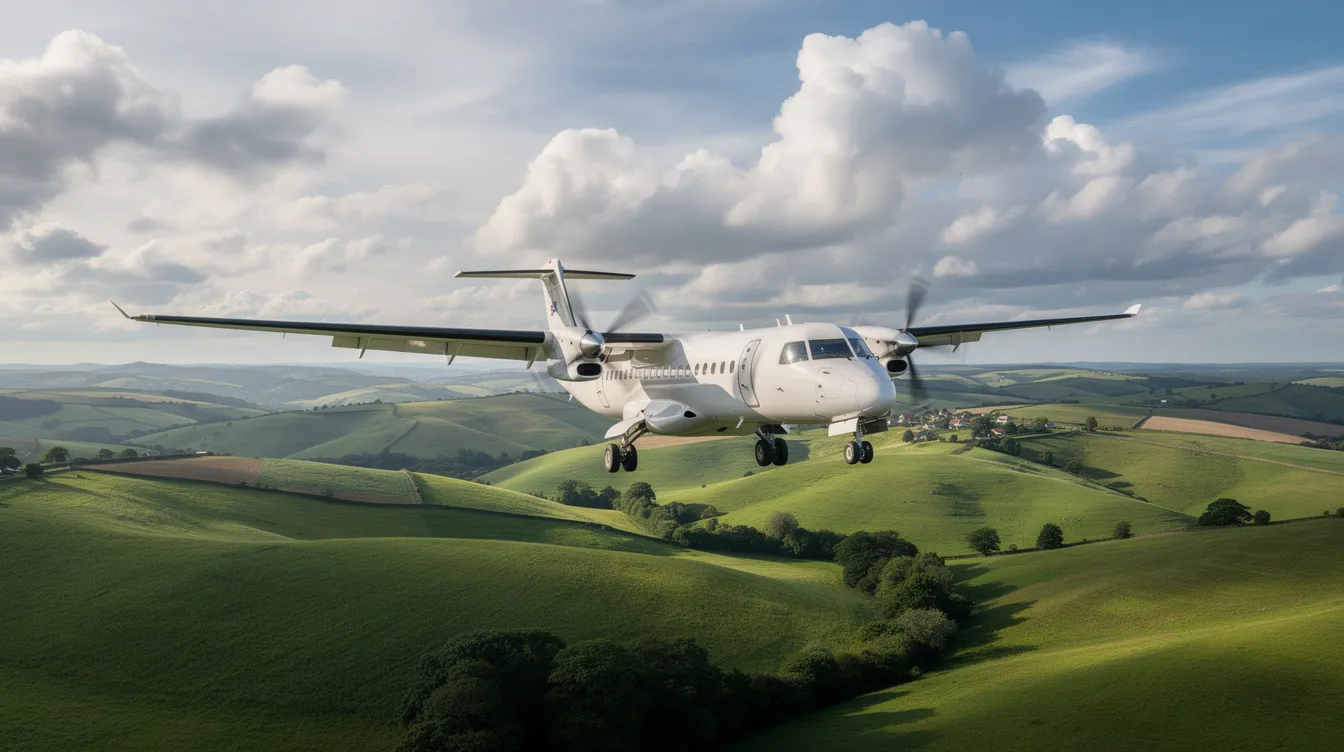
Choosing the longest-range turboprop comes down to mission profile, not just brochure numbers. On published range, the Beechcraft King Air 360ER leads business turboprops at 2,539 nautical miles, followed by the Pilatus PC-12 NGX and Daher TBM 960, but real-world range still shifts with payload, reserves, weather, and routing.
For corporate executives, high-net-worth travellers, and families comparing private aviation options, that difference matters: the right turboprop can cut charter costs, reach smaller airports, and handle regional to medium-distance trips efficiently without the burden of aircraft ownership. This guide breaks down the published and practical range of today’s leading turboprops, the factors that change what they can actually fly, how they compare with jets, and when booking one through Jettly makes more sense than choosing a jet.
The Beechcraft King Air 360ER holds the top published range among business turboprops at 2,539 nm, followed by the Pilatus PC-12 NGX (~1,803 nm with 4 passengers) and the Daher TBM 960 (~1,730 nm at long-range cruise). "Longest range" depends on configuration and mission profile.
Long-range turboprops can reach distances between 1,500 and over 2,500 nautical miles, but maximum range figures for turboprops typically assume minimal payload capacity. Real-world range with passengers and baggage is lower.
Range depends on several factors, including payload, cruise speed, weather, altitude, and fuel reserves — quoted brochure figures represent ideal scenarios that rarely match actual charter operations.
Long-range turboprops compete directly with light jets on 500–1,500 nm sectors while accessing shorter runways and delivering lower operating costs per hour, and tools like Jettly's private jet charter cost estimator help quantify those savings against comparable jets.
Jettly's marketplace lets travellers compare turboprop and jet options side by side with instant pricing. Explore charter options at jettly.com.
A turboprop uses turbine engines driving propellers, achieving high propulsive efficiency by combining gas turbine technology with large-diameter props. Turboprop aircraft combine high fuel efficiency with pressurised high-altitude flight, making them capable of covering serious distance on a single tank.
In private aviation, turboprops are a distinct category within business aviation, and long-range models fill the gap between regional piston aircraft and light jets. They typically cover 1,500–2,500+ nm and are often compared with light and midsize jets — and even some ultra-long-range jets on niche missions where runway access or cost matters more than speed, especially when evaluated alongside a broad selection of private charter aircraft.
Range figures are expressed in nautical miles under standard conditions with specific payload and fuel assumptions. As a charter broker, Jettly gives access to many turboprop types worldwide, supported by tools like its airport locator platform, letting travellers choose between top endurance models rather than being locked to one fleet.
Published maximum range is a theoretical ceiling. Several factors prevent it from aligning perfectly with real charter operations.
Key variables that affect range include:
Payload - more passengers and baggage mean less fuel or reduced efficiency
Cruise speed - flying slower extends range significantly; max-speed cruise shortens it
Altitude and temperature - hot or high-elevation airports reduce performance
Fuel reserves - legal requirements (typically 45 minutes plus alternate) subtract from usable fuel
Headwinds - even moderate headwinds can cut range by 100–200 nm
The design of turboprop wings incorporates aerodynamically optimised shapes and drag-reduction features, while high-aspect-ratio wings help reduce aerodynamic drag and maximise fuel efficiency. Still, physics limits what any airframe can do under real conditions.
Manufacturers like Textron Aviation, Pilatus, and Daher quote optimistic figures. For example, the King Air 360ER's published 2,539 nm maximum range might translate to roughly 1,800–2,100 nm in a real business mission with 6–8 passengers, baggage, and standard reserves.
No single model wins every scenario. But several turboprops stand out for exceptional range and mission flexibility in business aviation.
|
Model |
Max Published Range |
Typical Seats |
Cruise Speed |
Key Strength |
|---|---|---|---|---|
|
King Air 360ER |
2,539 nm |
8–11 |
~303 KTAS |
Twin-engine range leader |
|
King Air 350ER |
~2,253 nm (ferry) |
8–11 |
~312 KTAS |
Extended-range legacy platform |
|
~1,803 nm (4 pax) |
6–8 |
~290 KTAS |
Short-runway access, cargo door |
|
|
Daher TBM 960 |
1,730 nm |
Up to 6 |
~330 KTAS max |
Fastest single-engine turboprop |
|
~740 nm (full pax) |
70–78 |
~275 KTAS |
Regional airline fuel efficiency |
The ATR 72-600 is recognised for its fuel efficiency per passenger-mile in scheduled service, while the King Air 360ER sits at the top of the extended-range turboprop category, building on the 350ER's long-range design. Extended-range turboprops integrate additional fuel capacity into the airframe to increase range beyond standard models.
Some military and special-mission variants — maritime patrol turboprops, for instance — can fly very long endurance missions by trading payload for fuel. This article focuses on civil and business aviation applications.
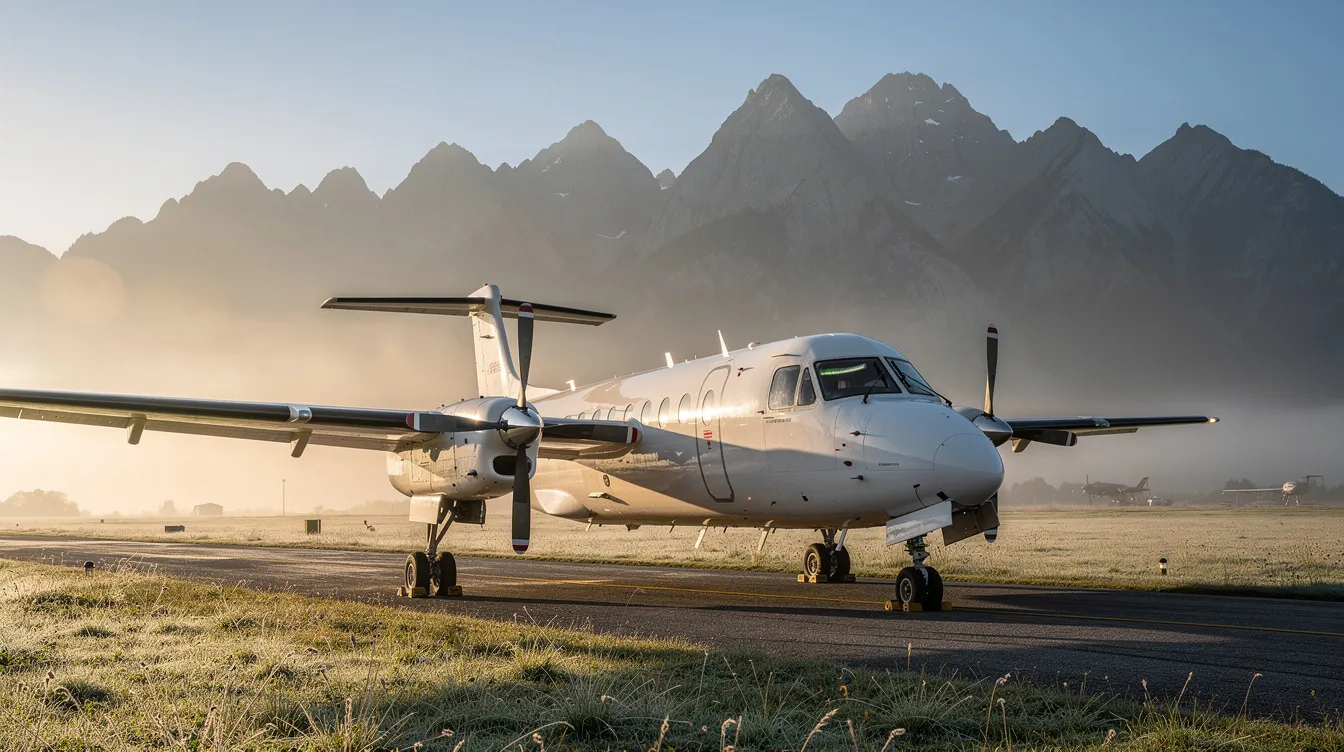
The Beechcraft King Air line is a benchmark in its category within business aviation, produced by Textron Aviation. The King Air 360 has a maximum range of 1,806 nautical miles, which converts to approximately 2,079 miles, while the King Air 360ER pushes to 2,539 nm with its auxiliary fuel system.
The King Air 360 has a maximum cruise speed of 312 KTAS, an operating ceiling of 35,000 ft, and a maximum takeoff weight of 15,000 lbs. Takeoff distance runs around 3,300–4,000 ft depending on model and conditions.
The cabin measures 19 ft. 6 in. long and 4 ft. 6 in. wide, configured in double-club or mixed layouts. The King Air 360 can accommodate up to 11 passengers and carry 1,150 lbs. of baggage. Collins Pro Line Fusion avionics, autothrottle, and digital pressurisation reduce pilot workload on longer legs.
For charter customers, the King Air fits routes of 500–1,500 nm between secondary airports - trips where cost efficiency outweighs the small flight time savings a jet might offer.
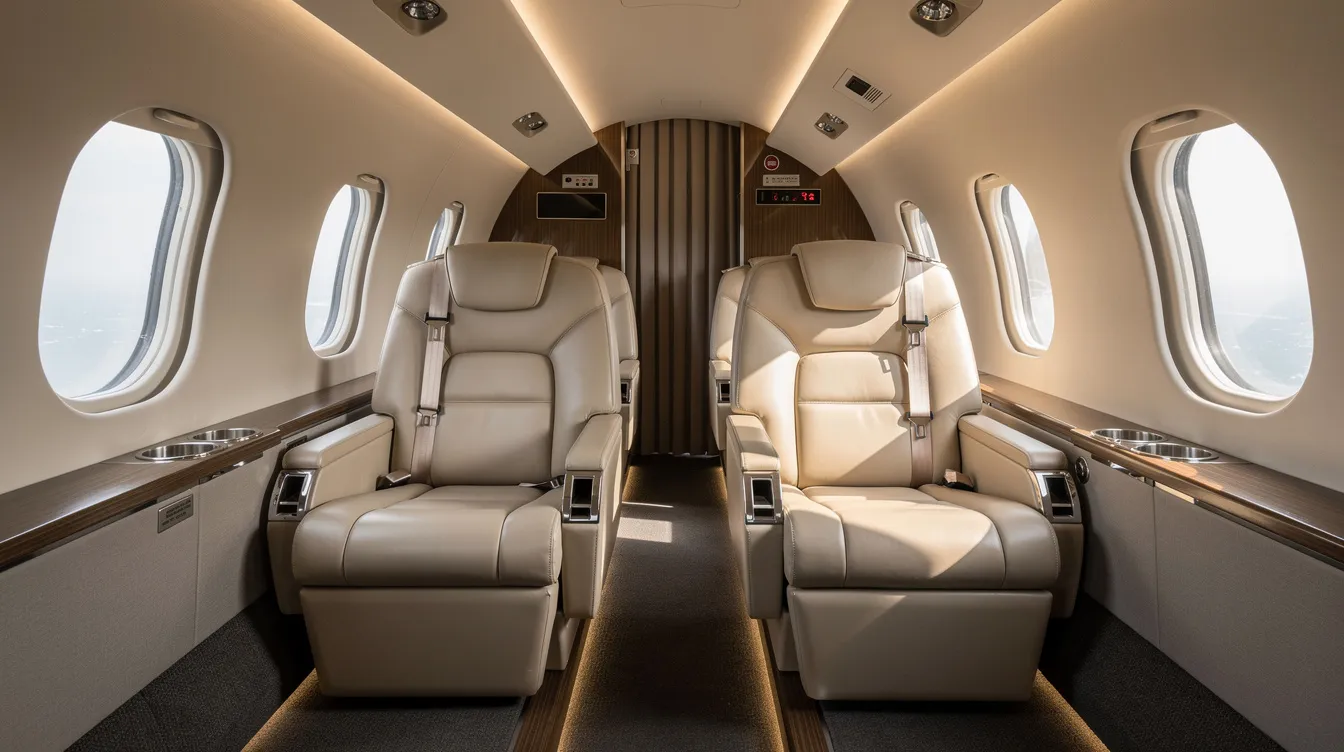
Long-range turboprops and ultra-long-range jets serve fundamentally different missions, though they occasionally overlap on medium-length routes.
Ultra-long-range jets can fly over 8,000 nautical miles — over 8,000 miles — without refuelling, and leading fractional operators like NetJets have built their reputation serving that segment of the market. Models like the Bombardier Global 8000, Gulfstream G800, and Dassault Falcon 10X connect distant cities like London to Beijing directly, and these manufacturers are close competitors in the ultra-long-range market. Long-range jets are ideal for intercontinental journeys, designed to prioritise comfort across continents so passengers can arrive more refreshed on those long sectors. They provide advanced air-filtration and low-altitude pressurisation systems. Long-range jets offer luxurious interiors with stand-up cabins, lie-flat beds, full galleys, living areas, and circadian lighting that rival high-end hotels.
Many turboprops achieve better fuel efficiency at subsonic speeds than turbofans, which is why they dominate on sub-2,000 nm sectors. Where jets bring speed and cabin space, turboprops bring access to shorter runways and significantly lower charter costs per hour, and travellers who understand how to book the cheapest private flights can often make turboprops even more cost-effective.
On Jettly, travellers can weigh cost per hour, total door-to-door travel time, airport choice, and passenger count when deciding between a King Air, a midsize jet, or an ultra long-range jet; note that the choice is usually driven by mission length, airport access, and cabin expectations, much like when comparing top private jet charter companies and platforms.
Despite the appeal of jets, long-range turboprops often deliver better value on specific missions within a continent or large country. Turboprops have significantly lower operating costs compared to light jets on regional missions, especially for operators moving up from smaller aircraft to more demanding routes. Single-engine turboprops burn less fuel per hour than twin-engine models, bringing even greater savings on shorter routes, and understanding how private jet charter pricing works helps put those turboprop savings in perspective.
Practical use cases for turboprop charter customers:
Regional business travel between cities with limited commercial service (e.g., Tulsa to Santa Fe, or secondary Canadian city pairs) where turboprops can land at local airports
Leisure or family trips to remote resorts, islands, or ski destinations with shorter runways
Medical, humanitarian, or cargo flights that benefit from large doors and unpaved-strip capability — modern turboprops can operate from unimproved airstrips using advanced landing gear designs
Cost-conscious corporate shuttles for small teams on repeated 500–1,000 nm routes, where flight-sharing models and crowdsourced private flights with shared seats can further reduce per-passenger cost
On a 700 nm route, a PC-12 or King Air may differ from a light jet by only 20–30 minutes of flight time but cost meaningfully less per hour. Jettly's marketplace allows side-by-side quotes for turboprops and jets on the same route, helping travellers compare real numbers instead of relying on assumptions.
Selecting the perfect aircraft is a practical decision based on mission profile, passenger comfort expectations, budget, and whether the route calls for one pilot or a full crew — not marketing claims alone.
Key decision criteria:
Route distance and weather - determines whether nonstop flight is realistic or a refuelling stop is needed
Runway length at origin and destination airports
Passenger count and baggage - including sports equipment and in-flight work needs like Wi-Fi
Desired cabin layout and level of comfort vs. pure cost efficiency
Jettly's instant-quote tool and private aviation advisors can match those criteria to specific models like the King Air 360ER, PC-12 NGX, or TBM 960, helping clients choose based on route, payload, and crew requirements, all operated by fully certified third-party carriers, while private jet memberships give frequent flyers more predictable access to those aircraft. Membership options help frequent flyers secure more predictable pricing on turboprop charters, while on-demand users benefit from transparent quotes and broad aircraft access, and structured jet card programs appeal to travellers who want fixed hourly rates.
Modern turboprops from Textron Aviation, Pilatus, and Daher meet the same regulatory standards as jets, sitting alongside many operators featured in broader guides to charter airlines and private flight providers. Jettly works exclusively with licensed air carriers that comply with FAA, EASA, or equivalent oversight, positioning itself as a flexible alternative to providers like NetJets for many travellers. Twin-engine models like the King Air 360ER offer engine redundancy, while single-engine types like the PC-12 and TBM have strong reliability records across thousands of hours in commercial and business service.
King Air and PC-12 class turboprops are often priced below comparable light jets on an hourly basis. Actual pricing varies by route, dates, repositioning needs, and availability. Use Jettly's instant pricing tool and jet card flight cost estimator for live quotes on specific aircraft and routes rather than relying on generic market averages.
Larger turboprops offer reclining club seats, quiet cabins, and sometimes divans for rest on late-evening legs, while for very long or intercontinental overnight sectors travellers often look to jets capable of flying internationally in private comfort. For true lie-flat sleeping on very long overnight sectors, heavy or ultra long range jets — such as a Dassault Falcon or Bombardier Global — are typically more suitable, and travellers are more likely to arrive rested thanks to the larger cabin room and amenities, though they also come with higher ownership and private jet operating costs.
Connectivity varies by operator and aircraft, but many King Airs and PC-12s in business aviation are equipped with Wi-Fi, power outlets, and modern avionics that support productive work in flight. Specify Wi-Fi and other features when requesting quotes through Jettly so the platform can match travellers with the right operators.
Enter your route and dates on Jettly's website, compare turboprop and jet options with instant pricing, and confirm a charter operated by a certified third-party carrier, using strategies similar to those outlined in Jettly's guide on how to get a seat on a private jet easily. Jettly's booking team can also help coordinate aircraft details and any crew-related requirements before confirmation, offering support comparable to what travellers see in guides on how to buy a seat on a private jet. The booking process takes minutes and shows real costs upfront.
The longest-range turboprop is not automatically the best choice for every trip. The King Air 360ER leads this comparison with a published range of 2,539 nautical miles, while the King Air 360, PC-12 NGX, and TBM 960 may better fit different passenger, baggage, runway, and budget needs. Actual range depends on payload, weather, reserves, and routing, so charter decisions should be based on the full mission rather than brochure figures alone.
For regional and medium-distance travel, a turboprop can offer efficient operating costs and access to smaller airports that may reduce ground-transfer time. Jettly helps travellers compare turboprops and jets with instant quotes across a broad aircraft marketplace. Jettly is a charter broker; flights are operated by properly certified third-party carriers.
Ready to experience private travel on your terms? Whether you need regional turboprop access into cities like Chennai in Tamil Nadu, Kolkata in West Bengal, or New Delhi in northern India, explore flight options or request a quote at https://www.jettly.com.
Share this post:
Jay Franco Serevilla
Nov 22, 2026
|
5
min read
Discover tips and trends in the industry.
5
min read
United Premium Economy vs Delta Premium Select: Which Premium Cabin Is Better for Long-Haul Flights?
When comparing United Premium Plus and Delta Premium Select for long-haul flights, the choice hinges on personal preferences such as seat width versus dining quality. United offers wider seats and consistent layouts, while Delta excels in meal service and entertainment options. Both cabins provide enhanced comfort over standard economy, making them appealing alternatives to business class.
Read More
5
min read
Delta Meal Selection: Complete Guide to Pre-Selecting Meals and Private Jet Alternatives
Delta's meal selection program allows eligible passengers to pre-select their in-flight meals, enhancing their travel experience. This guide details the eligibility, benefits, and comparison with private jet catering through Jettly, helping travelers make informed choices about their dining options. Understanding these features can significantly improve comfort and satisfaction during flights.
Read MoreStay updated with our latest insights and tips to elevate your journey with us.
MEMBERSHIPS AND ASSOCIATIONS



© 2026 Jettly Inc. All rights reserved.
Disclaimer: Jettly operates as a charter broker, offering access to a global digital jet charter marketplace. Jettly is not a direct air carrier and does not own or operate aircraft. All advertised flights are conducted by third-party air carriers that are fully licensed and hold the appropriate Part 135 or Part 121 certifications issued by the Federal Aviation Administration (FAA) or equivalent regulatory authorities under U.S. or foreign law. Jettly complies fully with the U.S. Department of Transportation's Part 295 and Part 298 Charter Broker regulations. Jettly does not carry additional liability insurance. Passengers are covered by aircraft operator insurance. TICO: 50023770


