



Login
Get Instant Pricing On 23,000+ Aircraft

>
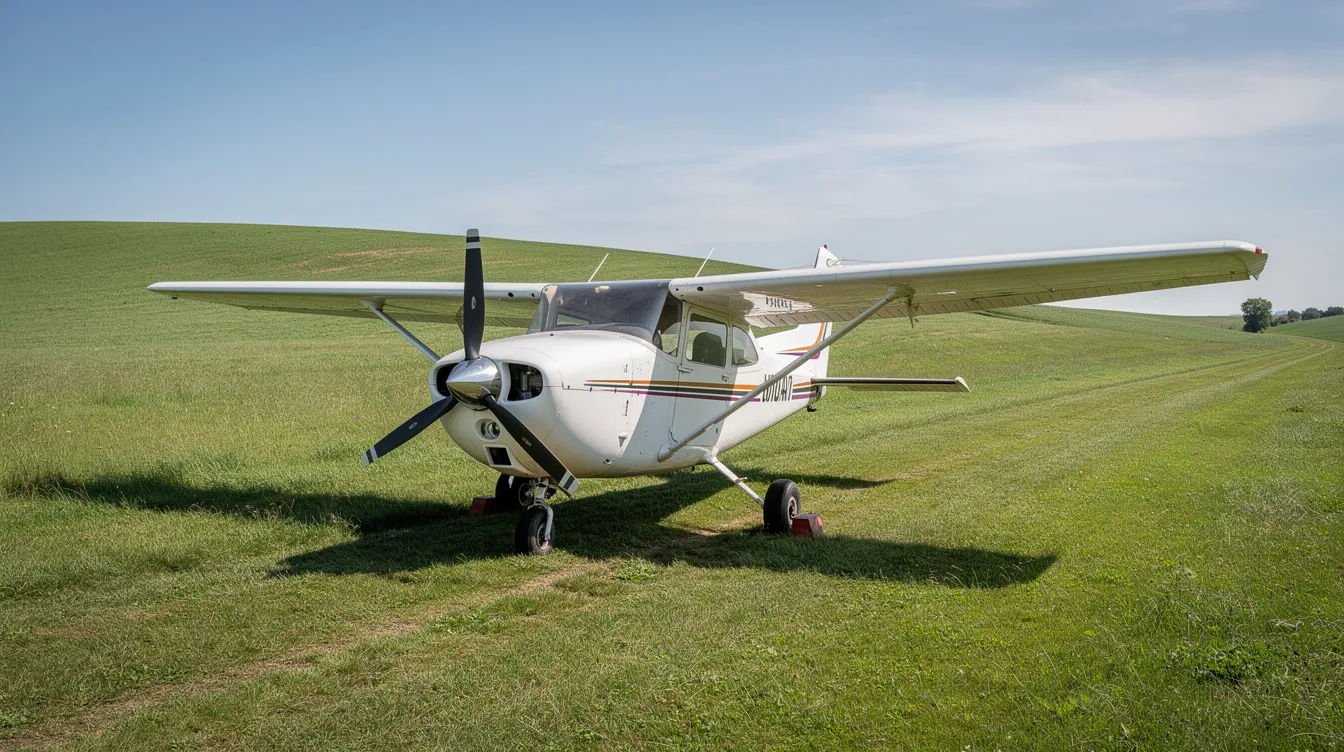
The Cessna 182 is a four-seat, single-engine aircraft that has been in production for over 50 years, earning its place as one of the most trusted platforms in general aviation. But understanding Cessna 182 seating capacity goes beyond counting chairs. Real-world payload limits, fuel planning, and passenger weights all determine whether those four seats can actually be filled on a given flight. Here is what travelers and aviation enthusiasts need to know.
The Cessna 182 can comfortably seat four people in all standard Skylane and Turbo Skylane models: one pilot, one front-right passenger, and two on a rear bench.
Actual seating on any given flight is constrained by useful load, passenger weights, baggage, and fuel. Full fuel with four large adults often exceeds the max takeoff weight.
Some lightly equipped older models and certain STC-upgraded aircraft handle four adults plus baggage more easily, while heavily equipped later models may require payload trade-offs.
Fixed-gear, retractable gear, and Turbo Skylane variants all share the same four-seat layout. Gear and engine differences affect performance, not passenger count.
Travelers needing four seats for regional missions can book a Cessna 182 or comparable single-engine piston aircraft through Jettly for cost-efficient private flights.
Every standard Cessna 182, including Skylane and Turbo Skylane variants, was introduced as a four-seat aircraft and is certified in that configuration. The layout includes one pilot seat at the front left, a front right seat, and a two-place rear bench. The aircraft is suitable for flight training and personal travel, and it remains a staple at flight schools worldwide.
However, "4 seats" does not always mean four adults plus full fuel and bags. Certified maximum seating and practical load on a specific flight are two different things. Pilots must calculate weight and balance for passenger and cargo loads before every departure.
Key cabin-entry details:
Passengers enter the Cessna 182 through side doors located on both the pilot and co-pilot sides.
The high wing design makes cabin access easier than low-wing alternatives, with no need to step over a wing spar.
No factory Cessna 182 model carries more than four occupants, even when operators reconfigure interiors for special missions.
For travelers comparing options on Jettly's platform, the Cessna 182 category is best suited to small groups of up to four people on shorter regional missions, while Jettly's broader private charter aircraft selection covers everything from light jets to long-range aircraft for larger parties and longer routes.
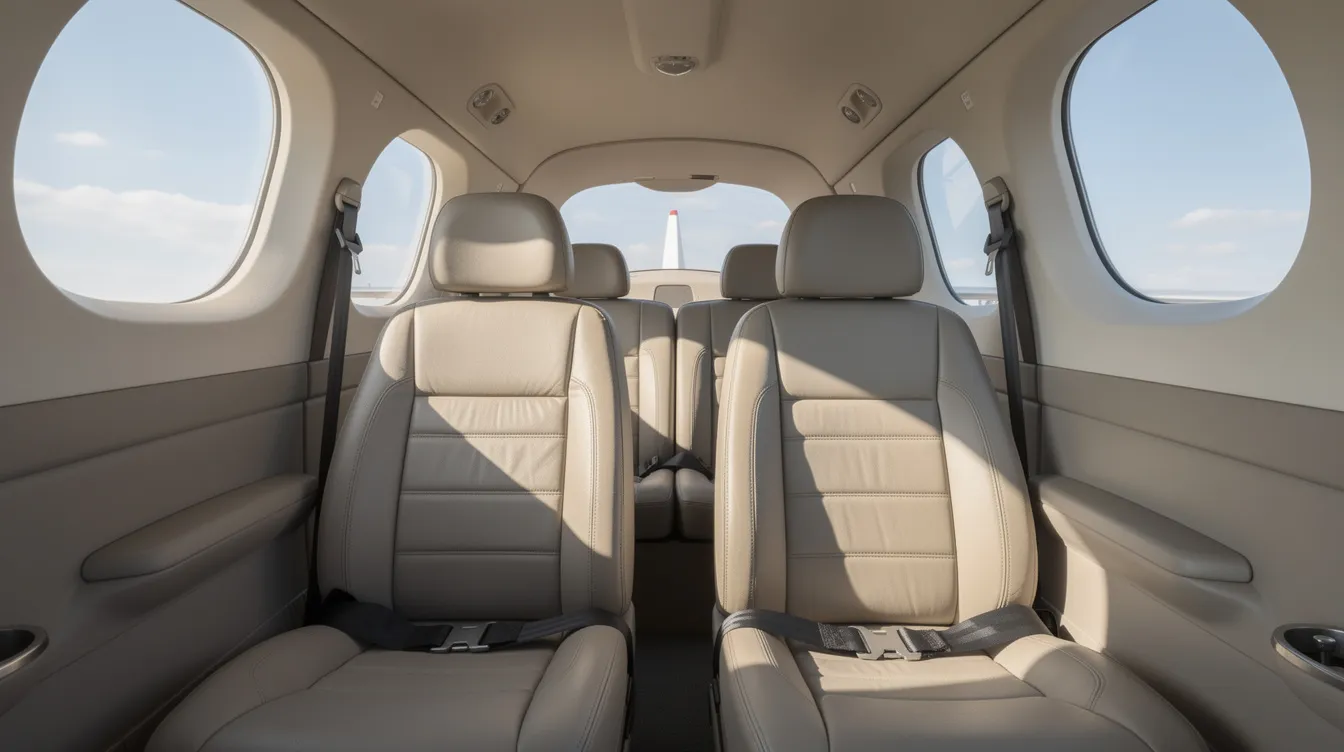
The standard seating arrangement consists of two front bucket seats and a rear bench seat. Each front seat includes control yokes, with the aft baggage area positioned behind the rear row. The aircraft has a bench seat in the rear that comfortably holds two passengers.
The cabin width of the Cessna 182 is approximately 42 inches, with headroom around 48.5 inches. Four average-sized adults fit reasonably well on flights of two to three hours. Taller passengers tend to prefer front seats for the extra legroom.
Interior trim has evolved across generations. Older Skylanes feature simpler upholstery, while modern 182T and Turbo Skylane models often come with upgraded leather seating and sound-reducing materials. The Cessna 182 is designed for family flying adventures, and it can carry up to 200 pounds of baggage split across two compartment areas, placing it among affordable planes and budget-friendly aircraft choices for owners and frequent flyers who prioritize operating costs alongside capability.
Unlike many two-seat trainers or light sport aircraft, the Cessna 182 was purpose-built as a true four-place tourer with meaningful room for bags, making it a strong pick among the best planes for a family of 4.
Useful load is the difference between basic empty weight and maximum takeoff weight. It defines how much combined payload—passengers, baggage, and usable fuel—an aircraft can carry. This number matters far more than the simple "four-seat" label.
The Cessna 182 has a useful load typically ranging from 1,100 to 1,250 pounds, depending on installed equipment. For reference, a modern 182T with a factory useful load around 1,110 pounds and full fuel of 87 usable gallons (roughly 522 pounds) leaves only about 588 pounds for occupants and bags. Four adults at 170 pounds each total 680 pounds—already a deficit before any luggage.
Fuel capacity can affect the overall payload capacity of the Cessna 182 significantly. The aircraft has a fuel burn rate of 12–13 gallons per hour, so shorter legs allow operators to carry less fuel and free up weight for passengers, while full tanks support a typical range of about 1,050 miles.
Weight distribution is critical in ensuring safe flight operations. The center-of-gravity envelope can restrict seating when carrying very heavy passengers or heavy aft baggage. Modifications such as gross weight increase STCs can raise the max takeoff weight to around 3,100 pounds on certain older models, improving practical four-seat capability. For a deeper breakdown, see Jettly's guide to Cessna 182 useful load and an overview of what affects the cost of one private flight when configuring missions around different payload and range needs.
On charter flights booked through platforms like Jettly, operators calculate weight and balance for each mission and may adjust passenger count or baggage allowance to stay within safe limits.
The standard Cessna 182 Skylane uses fixed tricycle gear. The retractable-gear R182 and turbocharged TR182 were introduced in the late 1970s. All of these variants retain four seats. The change in landing gear design does not increase seating capacity.
The Cessna 182 is powered by a 230-horsepower engine in most naturally aspirated models, giving the fixed-gear Skylane more power and a cruise speed of around 145 knots. The retractable landing gear models push closer to 170–175 knots under favorable conditions. Learn more about real-world speed figures in How Fast Does a Cessna 182 Fly.
Retractable gear components add weight and maintenance complexity, often reducing useful load slightly compared with similar fixed-gear models. This can marginally impact how easily the airplane carries four large adults plus full fuel.
Travelers comparing piston options for regional private flights should focus on the flight plan specifics—runway length, speed, and load—rather than expecting extra seats from a retractable gear version, and many also weigh these factors against affordable aeroplane rental costs and options when deciding between chartering and renting locally.
The Turbo Skylane (e.g., T182T) adds a turbocharged powerplant that improves climb performance at altitude. Its service ceiling exceeds 18,000 feet, making it capable over mountainous terrain. Seating remains four occupants.
Turbocharging, additional system components, and options like oxygen equipment add weight, which may slightly reduce useful load. This is one of the trade-offs later models present when flying with four heavier adults.
Many modern Cessna 182T and Turbo Skylane aircraft are equipped with a Garmin G1000 or G1000 NXi avionics package, which integrates GPS, traffic awareness, weather displays, and flight instruments into glass panels. These upgrades improve situational awareness and safety on cross-country flights but do not change seating capacity. Read the full Cessna 182T Skylane profile for specifications.
Charter customers on Jettly can filter for modern avionics when comparing aircraft, prioritizing Garmin G1000-equipped Turbo Skylane options for IFR or high-terrain routes with up to four travelers, or they can step back and review a broader guide to choosing the best personal plane before committing to a specific model.
The Cessna 182 can fulfill 90% of single-engine utility needs, which is why it remains one of the most versatile aircraft in its class, with many versions produced over a long run that reinforce its enduring utility role. Compared with the smaller Cessna 172, both carry four passengers, but the 182 delivers higher useful load, better climb, and more comfortable four-person operations, while its stable handling inspires confidence at every stage of flight. It is a reliable step up for groups that find a smaller Cessna too tight on payload.
For larger groups, the Cessna 206 (typically 5–6 seats) or the Cessna 208 Caravan (9+ seats) offer more cabin room but higher operating costs and longer runway requirements. The 182 sits in a practical middle ground as a versatile aircraft for short sectors, while aircraft like the Cessna 207 with 6–7 seats can bridge the gap for operators needing extra capacity without moving to a turboprop.
|
Feature |
Cessna 172 |
Cessna 182 |
Cessna 206 |
|---|---|---|---|
|
Seats |
4 |
4 |
5–6 |
|
Gross weight |
~2,550 lbs |
3,100 lbs |
~3,600 lbs |
|
Useful load |
~900–1,000 lbs |
~1,100–1,250 lbs |
~1,400+ lbs |
|
Cruise speed |
~120 kts |
~145 kts |
~150 kts |
A family of four people flying from a small regional airfield to a nearby resort is a textbook Cessna 182 mission. The aircraft's short-field performance and stability match that kind of adventure well. For travelers who eventually outgrow four seats, cabin-class piston twins such as the Cessna 340 with up to six seats provide a natural next step. For those exploring options, Jettly's best 4-seat airplane guide covers additional models.
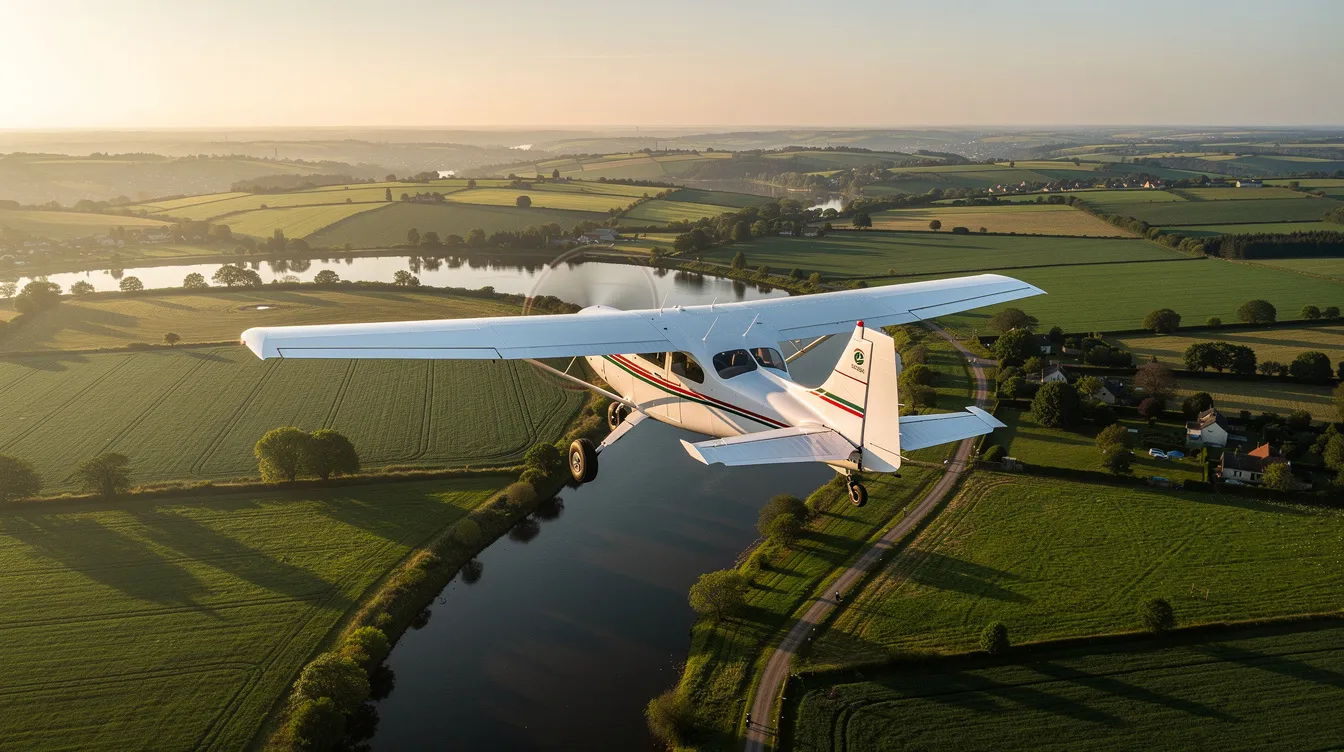
While the Cessna 182 is certified as a four-seat aircraft, some operators reconfigure the cabin for specific missions. It is widely used in the skydiving industry for its stability—operators often remove one or more passenger seats and install a step and modified door to carry jumpers.
Government, survey, and aerial photography roles sometimes call for rear-seat removal to make room for equipment racks, sensors, or camera operators. These modifications are conducted under approved supplemental type certificates or field approvals and are mission-specific. Standard private charter flights retain the normal four-seat layout.
When travelers book through a marketplace like Jettly, the listed aircraft configuration—including seat availability—is provided by the certified third-party operator, so customers know in advance how many passengers can be accommodated. Platforms that crowdsource private jet flights and share empty seats further optimize how those configurations are used in practice. Production today continues to reflect the standard four-seat arrangement for civilian models.
Seating capacity is often the first filter private travelers use when selecting an aircraft. For small groups considering a Cessna 182, Jettly's digital platform lets users request instant pricing for aircraft matching a four-passenger requirement—comparing options such as piston singles, small turboprops, or very light jets.
As a charter broker, Jettly does not operate aircraft directly. It connects customers with a large network of licensed, safety-vetted third-party carriers, including partners such as Dexter Air Taxi and other private jet operators, that provide accurate seating and payload details for each airplane. Those who fly frequently with three or four passengers may benefit from Jettly's private jet membership programs for more predictable pricing and easier access to the right class of aircraft.
Ready to compare seating capacities and explore routes? Request a quote via Jettly's cost estimator for your next four-person trip, use the jet card flight cost estimator to benchmark one-way pricing on popular routes, or explore how much it costs to charter a small plane.
It depends on the specific model's useful load, installed equipment, and the actual weights of passengers and baggage. On a modern 182T with roughly 1,110 pounds of useful load, full fuel consumes about 522 pounds, leaving approximately 588 pounds for everything else. Four 170-pound adults total 680 pounds—already over that margin. In practice, many operators reduce fuel on shorter legs or limit baggage to stay within the max takeoff weight of 3,100 pounds. Commercial operators calculate these limits for every flight.
Rear seats in a Cessna 182 are generally comfortable for average-sized adults on flights of up to about two or three hours. Legroom is adequate, though adjustability is limited compared with the front seats. For very tall passengers or extended legs, alternating seating positions helps. If comfort is a priority for longer missions, comparing a larger aircraft class through Jettly may be worth exploring while also considering how Jettly offers affordable private jet charter for those upgrades.
Every occupant requires a seat and restraint regardless of age. From a weight and balance perspective, lighter children reduce total load compared to full-sized adults. Charter operators factor actual body weights into their calculations, which can make it easier to use all four seats when some passengers are children. This is especially relevant for families planning a flight with mixed adult and child passengers, and many such travelers also look into how to buy a seat on a private jet when comparing shared options with whole-aircraft Cessna 182 charters.
The Cessna 182 seats four in a single compact cabin. Many light jets and turboprops available on Jettly seat 6–8 passengers and offer a separate, more spacious cabin with club seating, stand-up air space, and additional amenities. Travelers who frequently fly with more than four passengers, or who want extra baggage room and onboard services, should compare Cessna 182-type charters with turboprops and light jets using Jettly's instant-quote tools at jettly.com, especially if they are evaluating NetJets alternatives and more flexible private flying options.
On Jettly's platform, each listing includes aircraft type, seating configuration, and equipment details—such as whether the airplane is a Turbo Skylane and if it features a Garmin G1000 avionics package—and many users pair this with an airport locator tool for private flights to fine-tune routing. Travelers can review individual aircraft profiles and work with Jettly's support team to match their seating, performance, and avionics preferences before confirming a charter. Ready to find the right aircraft? Explore flight options or request a quote at jettly.com.
The Cessna 182 seating capacity is four occupants: a pilot, a front passenger, and two passengers on the rear bench. Whether all four seats can be used depends on the aircraft’s useful load, fuel, baggage, and passenger weights, so the operator must verify weight and balance for each flight.
For trips that need more payload, cabin space, or seats, compare other aircraft options through Jettly’s marketplace. Jettly is a charter broker connecting travelers with properly certified third-party carriers; explore flights or request a quote at https://www.jettly.com.
Share this post:
Jay Franco Serevilla
Nov 15, 2026
|
5
min read
Discover tips and trends in the industry.
5
min read
Flight Time From NY to London: What to Expect on Commercial and Private Jets
The flight time from New York to London typically ranges from 6.5 to 7.5 hours for commercial flights, while private jets can complete the journey in about 6 to 7 hours. Factors such as jet stream conditions, airport choice, and aircraft type significantly influence travel times. This guide provides insights into optimizing your trip, whether flying commercially or privately.
Read More
5
min read
How Far in Advance Should I Book a Flight? (Private & Commercial)
Understanding how far in advance to book a flight is crucial for travelers. For commercial flights, the ideal booking window is typically 1 to 3 months ahead, while private jet charters can often be arranged closer to departure. Factors like destination, seasonality, and route type significantly influence the best time to secure your tickets.
Read MoreStay updated with our latest insights and tips to elevate your journey with us.
MEMBERSHIPS AND ASSOCIATIONS



© 2026 Jettly Inc. All rights reserved.
Disclaimer: Jettly operates as a charter broker, offering access to a global digital jet charter marketplace. Jettly is not a direct air carrier and does not own or operate aircraft. All advertised flights are conducted by third-party air carriers that are fully licensed and hold the appropriate Part 135 or Part 121 certifications issued by the Federal Aviation Administration (FAA) or equivalent regulatory authorities under U.S. or foreign law. Jettly complies fully with the U.S. Department of Transportation's Part 295 and Part 298 Charter Broker regulations. Jettly does not carry additional liability insurance. Passengers are covered by aircraft operator insurance. TICO: 50023770


