



Login
Get Instant Pricing On 23,000+ Aircraft

>
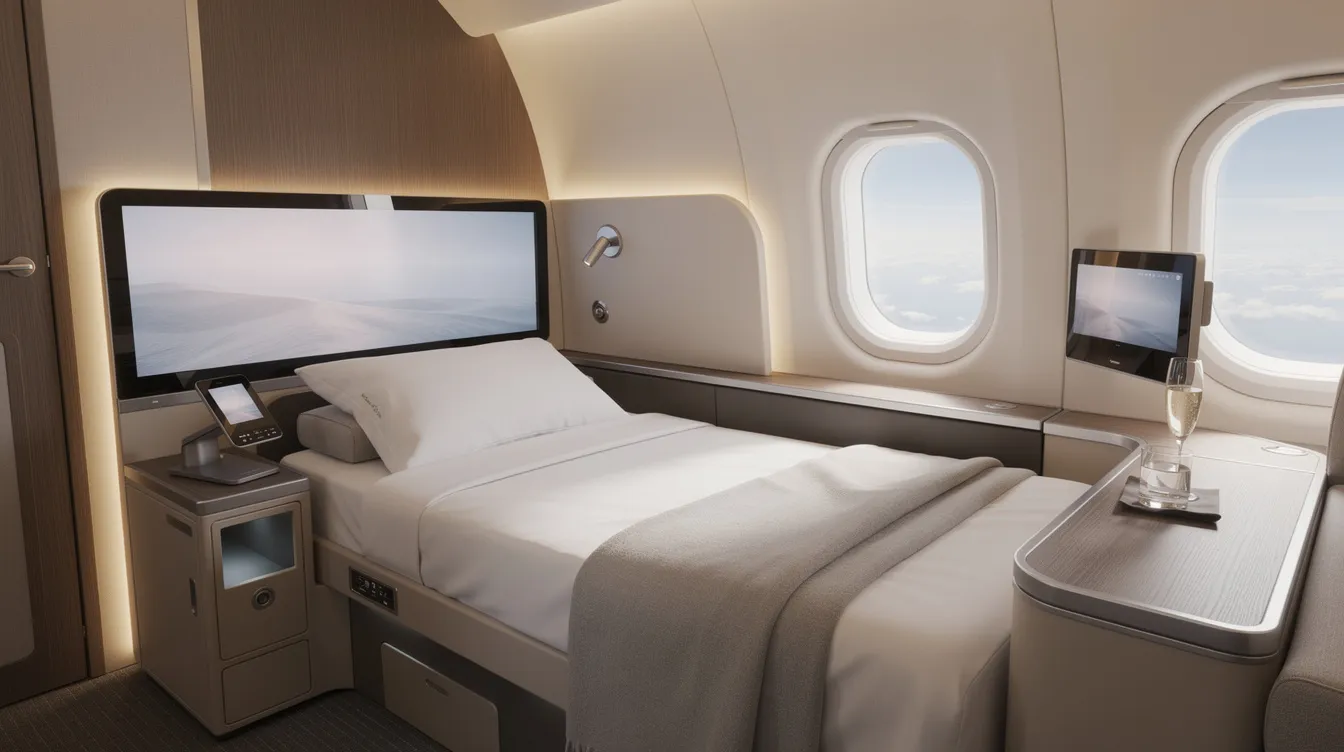
First class remains the top tier of commercial aviation, but fewer airlines offer it today than a decade ago. For travelers weighing the cost of a first-class ticket against the flexibility of a private jet charter, the math is no longer straightforward. This guide breaks down what first class includes, what it costs on real routes, and when chartering through a platform like Jettly delivers better value.
First class in commercial aviation refers to the highest cabin offered by airlines such as Singapore Airlines, Emirates, and Lufthansa. It sits above business class in price, space, and service, with lie-flat beds, multi-course dining, and enclosed suites on select long-haul routes like London to New York or Dubai to Sydney.
First class offers larger seating, priority airport processing, and upgraded dining compared to economy class, but it costs several times more per ticket. A round-trip first class fare from New York to London typically runs $9,000 to $18,000 per person.
Many executives and high-income travelers now compare first-class tickets against on-demand private jet charters. For groups of four to eight, the total cost of multiple first-class tickets can approach or exceed a private jet charter on shorter routes.
Jettly, a digital charter broker, gives travelers access to over 20,000 aircraft across turboprop, light jet, midsize, and heavy jet classes. Its instant-quote tools let users compare aircraft options and pricing against first-class fares in minutes.
The right choice depends on route length, number of travelers, schedule flexibility, and how much privacy matters. This article walks through each factor so readers can decide when first class fits and when a private jet through Jettly is the better option.
The term "first class" today covers a range of products, from enclosed suites with closing doors to recliner-style seats that look more like a business class cabin from five years ago. Airlines often feature fully lie-flat beds in international first class, but the specifics vary by carrier and aircraft.
As of 2026, true first class cabins still fly on select long-haul routes. Singapore Airlines' new first class on the A350-900ULR features a 1-2-1 layout with four suites, 80-inch fully flat beds, and 32-inch 4K screens. Lufthansa's Allegris "Suite Plus" offers fully enclosed suites with personal wardrobes and heated seats. Emirates' "Game Changer First" on the 777-300ER has floor-to-ceiling doors. Meanwhile, carriers like Cathay Pacific have been phasing out some first-class configurations, and most U.S. airlines no longer offer a dedicated international first-class product at all.
The cabin class tiers are: economy, premium economy, business class, and first class. Each step up adds space, service, and cost. Flying first class offers more legroom and comfort than economy, plus priority check-in and security access, additional baggage allowances with priority handling, chauffeur service on some airlines like Emirates, and access to dedicated first-class lounges.
Here is how the tiers compare on a typical long-haul route:
|
Feature |
Economy |
Business Class |
First Class |
|---|---|---|---|
|
Seat pitch / Bed length |
~32-35 in / recline only |
Lie-flat ~76-80 in |
Fixed or convertible bed, 80 in+, sometimes double |
|
Privacy |
Open cabin, shared rows |
Partitions, direct aisle access |
Enclosed suites with doors on many carriers |
|
Baggage allowance |
1-2 bags, 23 kg each |
2-3 bags, up to 32 kg each |
More pieces, higher weight limits |
|
Lounge access |
None or paid |
Business lounges |
Exclusive first-class lounges |
|
Price range (NYC-London RT) |
$800-$2,500 |
$9,000-$18,000+ |
The cost of first class is several multiples of an economy ticket. But the comparison travelers should really make goes beyond the ticket price: total journey time, access to smaller airports, and schedule control all factor into whether first class or a private jet charter is the right fit.
First class passengers today fall into three broad groups: corporate travelers, leisure splurgers, and frequent flyers gaming loyalty programs.
Business executives on long-haul routes like New York to Tokyo or Frankfurt to Singapore often fly first class so they can land rested and ready for meetings. First class can enhance comfort and reduce travel fatigue on long flights, which is the core reason corporate travel policies cover premium cabins on routes exceeding eight hours.
Leisure travelers making milestone trips also fill first class cabins. A couple booking a honeymoon flight from Los Angeles to Bora Bora or London to the Maldives may treat first class as part of the experience. These passengers typically pay full fare or redeem loyalty points.
A growing number of high-income travelers now compare the cost of two to four first-class tickets against chartering a light jet through Jettly, particularly on shorter routes where private aviation can match or beat the per-person price. Frequent flyers with status or mileage balances can use upgrades to access first class at a fraction of the published fare. Private jet charter through Jettly uses transparent per-flight pricing or membership programs instead.
The gap between first class and business class has narrowed on newer aircraft, but first class still leads on three fronts: space, service ratio, and personalization.
First class seats usually feature fully flat beds stretching to roughly 200 cm (80 inches). Some airlines, like Singapore Airlines and Lufthansa, offer center suites that convert into double beds. Closing doors on suites like Emirates First Class on the Boeing 777-300ER create near-total visual privacy. First class offers more personalized service with fewer passengers per flight attendant; a cabin of six to eight suites may have two or three dedicated crew members.
First class dining includes multi-course meals served on high-quality dishware, often designed by named chefs with seasonal menus. Champagne is standard; airlines like Air France serve vintage selections in La Première. First class includes higher-quality snacks and premium beverages during the flight, and first class passengers often enjoy complimentary beverages throughout the flight, from pre-departure drinks to a nightcap before landing.
Entertainment screens run up to 32 inches with 4K resolution. Wi-Fi is often complimentary. Amenity kits include skincare from brands like La Mer or Aesop, and bedding quality rivals five-star hotels.
Still, even the best first-class suite shares the cabin with other passengers. A private jet gives the chartering group the entire aircraft. Here is how the two compare:
|
Feature |
First Class (Major Airline) |
Light/Midsize Private Jet |
|---|---|---|
|
Layout |
Up to 8 suites, 1-2-1 configuration |
6-9 seats, full cabin for your group |
|
Privacy |
Suite-level; shared cabin space |
Cabin-level; all passengers from same party |
|
Meetings / Calls |
Limited; background noise, other passengers |
Full discretion; calls and meetings at will |
|
Noise |
Engine and passenger ambient noise |
Quieter; fewer ground handling delays |
Beyond the in-cabin differences, a true first-class product is defined by how it balances comfort and privacy. Even the best airline product cannot replicate the cabin-level seclusion of a private aircraft.
Travelers comparing first class to private jets often focus on the seat. The bigger differences show up in timing, routing, and group economics.
Private jet travel provides greater flexibility than commercial flights. First class follows fixed airline schedules and hub airports. A private jet can depart from thousands of smaller airports; a flight from Teterboro instead of JFK, or Farnborough instead of Heathrow, can save over an hour of ground time each way. For a same-day charter, there is no need to build a trip around airline timetables.
Group economics shift the cost equation. For four to eight passengers on a route like New York to Miami or Toronto to Vancouver, the total cost of multiple first-class tickets can approach or exceed the cost of chartering a midsize jet. Travelers looking to reduce per-person pricing further can crowdsource private jet flights and share empty seats, while in-flight catering on private jets remains customizable to passenger preferences, from dietary restrictions to specific wine selections, without the fixed menu cycle of an airline.
A private jet cabin serves as a boardroom, lounge, or family room for the entire flight. First class offers privacy at the seat level; a charter offers it at the cabin level. For executives conducting confidential business or families traveling with children, that distinction matters.
First class still follows airline baggage rules with per-piece weight and dimension limits. Private jets allow more flexible baggage arrangements, including oversized sports equipment or sensitive cargo, subject to the aircraft's payload capacity.
Jettly acts as a charter broker, not an airline or direct air carrier. It connects travelers to certified third-party operators, such as FAA Part 135 carriers in the U.S., and allows choice among aircraft classes based on route and budget.

Headline prices can mislead. Total trip value, including time saved, airport transfers, and the number of travelers, should guide the decision.
On long-haul routes, first class is almost always cheaper for one or two people. A round-trip first-class ticket from New York to London runs roughly $9,000 to $18,000 per person. Negotiated or consolidator fares can drop that to around $5,500. Chartering a heavy jet for the same route costs $75,000 to $120,000 one way, making the per-person math unfavorable for small parties.
The picture changes on shorter routes with more passengers. Four to six travelers flying Los Angeles to Las Vegas or Paris to Geneva face combined first class or business class fares in the $15,000 to $30,000 range. A light jet charter through Jettly for the same route can fall in a similar range. For a more holistic view of private aviation expenses beyond single-trip pricing, including ownership and fractional options, see Jettly's guide on how much a private jet really costs alongside its private jet charter costs in 2026.
Airline sales, mileage redemptions, and upgrades can make first class cheaper for solo travelers. Private charters tend to offer better value when most seats on the aircraft are filled. Hourly rates for private jets range from roughly $3,000 to $4,000 for a light jet, $3,800 to $5,500 for a midsize, and $8,000 to $13,000 for a heavy jet.
Jettly's instant pricing tools let users test scenarios by comparing different aircraft classes, departure times, and airports. The Charter Cost Estimator, together with Jettly's dedicated jet card flight cost estimator, shows whether a charter or first-class tickets better fit the travel plan.
|
Factor |
First Class (per person) |
Private Jet via Jettly (per aircraft) |
|---|---|---|
|
NYC-London RT |
$9,000-$18,000 |
$150,000-$240,000 (heavy jet) |
|
LA-Las Vegas one-way (4 pax) |
$1,500-$3,000 each ($6,000-$12,000 total) |
$6,000-$10,000 (light jet) |
|
NYC-Miami one-way (6 pax) |
$2,000-$4,000 each ($12,000-$24,000 total) |
$10,000-$18,000 (midsize jet) |
On the LA-Vegas and NYC-Miami examples, the per-person cost of a charter can match or beat first class, especially once you factor in the two to three hours of airport time saved at each end.
Much of the difference between first class and private jets appears on the ground, not in the air, and understanding the broader private and charter airline landscape helps put these experiences in context.
First class passengers have access to exclusive airport lounges with amenities including hot meals, showers, spa treatments, and quiet work areas. The Emirates First Class Lounge in Dubai and Cathay Pacific's "The Wing" in Hong Kong set a high bar. First class can provide a smoother airport experience through expedited processing: dedicated check-in counters, fast-track security lanes, and priority boarding.
Private jets allow for direct airport access without layovers. Flights typically use Fixed Base Operators (FBOs), which are smaller terminals with direct ramp access and minimal waiting. Passengers can arrive 15 to 30 minutes before departure instead of two to three hours. The history of commercial aviation has always involved queuing; FBOs eliminate most of it.
Jettly-booked flights use FBOs where available, allowing faster boarding, easier ground transportation coordination, and more discreet arrivals. Airlines may offer limited chauffeur drives in select cities. Many private operators coordinated through Jettly can arrange ground transportation, in-flight catering, and special requests through the broker.
Travelers who prioritize minimal airport time and maximum privacy tend to lean toward private jet charter. Those comfortable navigating large hub airports, and who value the lounge experience as part of the trip, may find first class adequate.
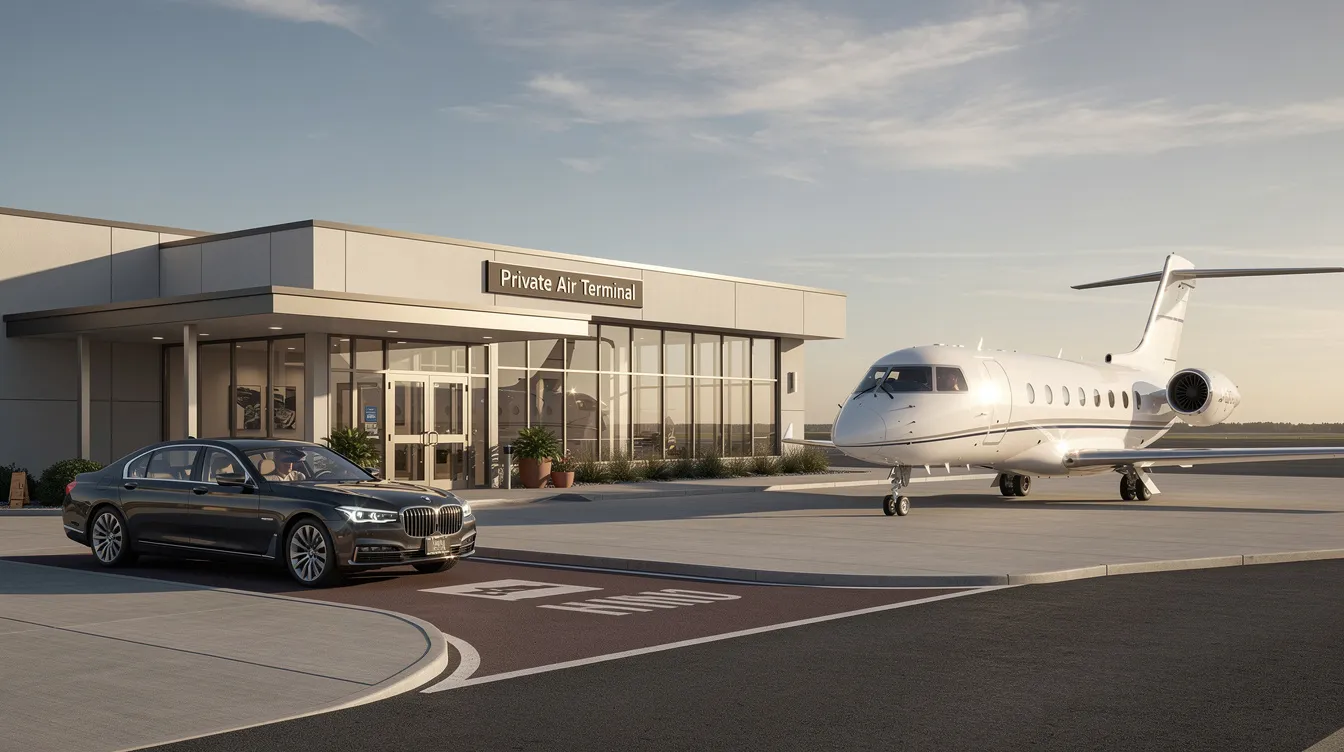
Jettly's role is to present a clear alternative to first class and business class for travelers who value schedule control, aircraft choice, and transparent pricing. Rather than replacing airlines, the platform gives travelers a way to compare both options on the same trip.
Private jets offer access to over 20,000 unique aircraft through Jettly's marketplace, spanning turboprop, light jet, midsize, super midsize, and heavy jet classes. No long-term ownership commitment is required, whether you're booking frequent transcontinental hops or a one-off itinerary such as a private jet charter in Kolkata, West Bengal. Travelers can browse the full range on Jettly's website.
The booking workflow works like this: enter a route and dates (New York to Miami, Toronto to Vancouver, London to Nice), receive instant quotes across aircraft types, compare features like cabin height, Wi-Fi availability, and baggage capacity, then place a booking request. Instant digital booking is available for private jet rentals, cutting out the back-and-forth of traditional charter brokers.
Frequent flyers can use Jettly membership programs, including structured jet card programs with fixed hourly rates, for more predictable pricing and service levels. The FLYT program, for example, offers hourly rates starting at $2,400 for turboprops and $2,800 for light jets on 25-hour plans. Occasional travelers can book trip by trip, similar to choosing first class only when the route and occasion justify the spend.
Flights booked through Jettly are operated by independent, properly certified carriers. In the U.S., most operate under FAA Part 135, and operators carry safety certifications such as ARGUS, IS-BAO, or Wyvern ratings. Travelers comparing providers may find it useful to study how industry leaders like NetJets structure their private aviation services. Travelers can review operator credentials and safety records on the platform before confirming a booking.
Ready to compare first class with a private jet for your next trip? Request an instant quote at jettly.com.
There is no single "best" class. The right choice depends on route length, the number of travelers, schedule flexibility, and desired privacy.
First class is usually the better fit when:
Traveling solo or as a couple on long-haul, high-frequency routes with strong airline products (London to Singapore, New York to Tokyo)
Using miles, upgrades, or corporate travel budgets that subsidize the fare
The airline's ground experience (lounges, chauffeur service) is part of the appeal
Private jet charter through Jettly often wins when:
Four to eight passengers travel together on short or medium-haul routes
The itinerary involves multiple stops in one day (several Texas or California cities, for example)
Airline first class is sold out on a last-minute trip
The destination airport has no scheduled first class service
Some travelers mix both: a private jet for a complex, multi-city regional leg and first class for the long-haul transatlantic or transpacific segment. For price-sensitive flyers exploring on-demand charter in any region, Jettly also outlines affordable private jet charter strategies. Jettly's instant-quote tools help users test these scenarios in minutes rather than manually comparing multiple first-class fares and airline schedules.
Not always. On many newer aircraft, business class now includes lie-flat beds, direct aisle access, and privacy doors. The gap to first class has narrowed on routes served by carriers like Qatar Airways or Japan Airlines. Travelers should compare the specific seat product, service ratio, and price on their exact route before assuming first class is worth the premium. On some flights, the difference between business and first comes down to a slightly larger screen and better champagne.
Jettly lets users filter search results by aircraft size, range, cabin features, and passenger capacity. Instead of selecting an airline cabin class, travelers select an aircraft class (turboprop, light jet, midsize, heavy). The platform shows the total cost for the group, so travelers can compare it directly with the combined price of first-class tickets for the same route.
For solo travelers on long-haul routes, first class is almost always cheaper. For groups of four to eight on shorter routes (under three hours of flight time), charter quotes from Jettly can match or beat the combined cost of multiple first class tickets. The break-even point depends on the route, the number of passengers, and how much value travelers place on the time saved at airports.
Jettly works only with properly certified third-party air carriers. In the U.S., these operators must hold FAA Part 135 certification. Many also carry third-party safety ratings from organizations like ARGUS or Wyvern. Travelers should review operator credentials and safety ratings presented on the platform before confirming any booking.
Travelers can select more fuel-efficient aircraft classes, such as modern turboprops, through Jettly's marketplace. The platform's support team can also connect passengers with external providers to arrange carbon offsets for their flights. This adds an environmental consideration that does not exist in most standard first-class bookings, where the airline controls aircraft selection and fuel use.
First class can be a strong choice for solo travelers and couples on long-haul routes, especially when upgrades or airline loyalty points reduce the fare. For groups traveling on shorter routes, or passengers who value schedule control, privacy, and access to smaller airports, a private jet charter may offer a more practical fit. The right comparison depends on the route, group size, total cost, and time saved on the ground.
Jettly helps travelers compare aircraft options and request instant quotes across a global marketplace. Jettly is a charter broker; flights are operated by properly certified third-party carriers. Ready to compare first class with private travel? Explore flight options or request a quote at https://www.jettly.com.
Share this post:
Jay Franco Serevilla
Nov 26, 2026
|
5
min read
Discover tips and trends in the industry.
5
min read
First Class Air Travel: What It Is, Who It Suits, and How It Compares to Private Jets
This guide explores the nuances of first-class air travel compared to private jet charters. It highlights the benefits of first class, including luxury amenities and priority services, while also discussing when private jets may offer better value, especially for groups. Factors like route length, traveler numbers, and privacy preferences are key in making the right choice.
Read More
5
min read
How Fast Does Air Force One Travel? A Practical Speed & Travel Guide
Air Force One, primarily the VC-25A, typically cruises at speeds of 575-580 mph, with a maximum speed of around 630 mph. Its travel time is influenced by factors like air traffic control priority and atmospheric conditions, making it competitive with commercial flights. The upcoming VC-25B is expected to maintain similar speeds while improving efficiency and technology.
Read MoreStay updated with our latest insights and tips to elevate your journey with us.
MEMBERSHIPS AND ASSOCIATIONS



© 2026 Jettly Inc. All rights reserved.
Disclaimer: Jettly operates as a charter broker, offering access to a global digital jet charter marketplace. Jettly is not a direct air carrier and does not own or operate aircraft. All advertised flights are conducted by third-party air carriers that are fully licensed and hold the appropriate Part 135 or Part 121 certifications issued by the Federal Aviation Administration (FAA) or equivalent regulatory authorities under U.S. or foreign law. Jettly complies fully with the U.S. Department of Transportation's Part 295 and Part 298 Charter Broker regulations. Jettly does not carry additional liability insurance. Passengers are covered by aircraft operator insurance. TICO: 50023770


