


Login
Get Instant Pricing On 23,000+ Aircraft

>
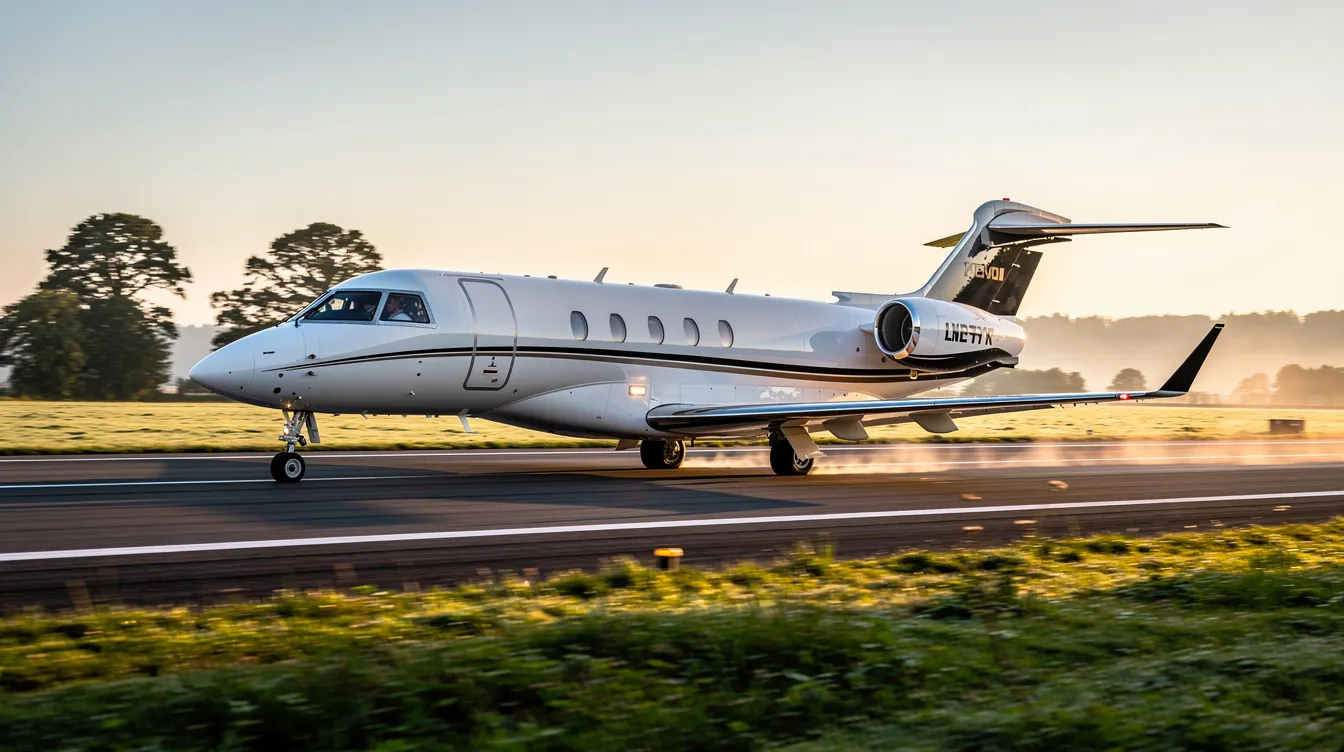
Understanding phenom 100 takeoff distance is essential when booking a private charter, especially if your trip involves shorter runways or high-elevation airports. Here is what the data says and how it affects your next flight.
A typical Embraer Phenom 100 takeoff distance is about 3,190 feet (approximately 972 meters) at max takeoff weight on a standard day at sea level, placing it among the stronger performers in the very light jet category.
The aircraft can operate comfortably from runways around 3,500–4,000 feet and, under optimal conditions, from runways as short as 3,000–3,500 feet.
Runway requirements shift significantly with weight, temperature, elevation, runway surface condition, and obstacles, sometimes adding thousands of feet to the baseline number.
High temperatures and density altitude reduce engine thrust and aerodynamic performance, increasing takeoff distance, while wet or icy runway conditions and uphill slopes also extend the required takeoff roll.
Headwinds reduce takeoff distance, whereas tailwinds increase it.
The Phenom 100 can accommodate up to seven passengers, has a maximum range of 1,178 nautical miles, cruises at 406 knots at maximum cruise, and reaches a service ceiling of 41,000 feet.
Annual operating cost for the Phenom 100 is approximately $1,118,248, with total fixed costs of $202,225 annually and total variable costs around $524,592. Hourly operating cost is about $1,748.64, with fuel consumption at 113 gallons per hour.
Jettly helps travellers match runway length, aircraft performance, and mission profile when choosing between the Phenom 100 and other light jet options.
The Embraer Phenom 100 has a published takeoff distance of 3,190 feet (972 meters) at maximum takeoff weight, sea level, standard day conditions, dry runway, and zero wind. Earlier variants show figures around 3,125 feet, while the upgraded Phenom 100EV refines performance slightly through improved engines and avionics.
These are "book values" from manufacturer performance data, assuming normal configuration and ideal conditions. In practice, corrections for temperature, pressure altitude, runway slope, and surface type are applied before every departure.
Since its first delivery in December 2008, the Phenom 100 has established itself as a capable short-field performer. The aircraft reaches a maximum cruise of 406 knots, has a service ceiling of 41,000 feet, and achieves a maximum flying range of 1,178 nautical miles with NBAA IFR reserves and four passengers. For charter customers, shorter takeoff distance means access to more secondary airports closer to city centres and resort destinations, which is where Jettly's airport locator tool helps match aircraft performance with suitable fields.
"Takeoff distance" is not a single universal number. Different regulatory and manufacturer definitions exist, and understanding them helps clarify what published figures actually mean.
Takeoff ground roll: distance from brake release to liftoff, when the wheels leave the runway.
Takeoff distance to 35–50 ft: distance required to clear an obstacle at a specified height, which is what most performance charts for a business jet like the Embraer Phenom 100 use.
Published brochure numbers typically refer to the distance to clear a 50-foot obstacle at max takeoff weight and sea level on a standard day. The landing distance, by comparison, is 2,430 feet under similar conditions.
For Part 135 operators, regulatory margins require additional performance reserves. Charter flights may plan with longer minimum runway lengths than the bare brochure number suggests.
The Phenom 100 is a very light jet, so changes in operating conditions can noticeably affect runway needs compared with larger, more powerful aircraft. Here are the major variables:
Aircraft weight: Higher fuel load, more passengers and baggage, and optional equipment increase takeoff distance. At full fuel, payload capacity is roughly 580–650 lb depending on variant. Fuel consumption runs about 113 gallons per hour, so longer trips with more fuel reduce available payload.
Pressure altitude: Operations from high-elevation airports like Aspen (KASE, ~7,820 ft) require substantially more runway due to thinner air. The EV variant claims a reduction of over 1,000 feet in takeoff distance at altitude-affected airports.
Temperature: "Hot and high" conditions—summer afternoons in Phoenix or Mexico City—increase density altitude and reduce engine thrust and wing lift.
Runway surface and slope: Wet, contaminated, or uphill runways increase required distance. A dry, level, paved runway allows for the shortest takeoff distance, while wet or icy conditions can add 10–20% to the takeoff roll.
Wind: Headwinds reduce takeoff distance while tailwinds significantly increase it. Many operators limit tailwind departures on shorter runways.
Obstacles: Significant obstacles near the runway increase the required takeoff field length.
Consider the difference: a cool morning departure at sea level with four occupants might need just over 3,000 feet, while the same flight on a hot afternoon from a 5,000-foot elevation airport could push requirements well past 4,500 feet, forcing weight reductions or schedule changes, or even switching to a different aircraft type from Jettly's extensive private charter aircraft inventory.

The Embraer Phenom family is an entry-level jet designed for short- to medium-range missions with four passengers to six occupants. In some configurations with an optional side-facing seat, the cabin can accommodate up to seven passengers, though most charter missions load four to five for comfort and performance balance.
The Phenom 100EV upgraded each Pratt & Whitney Canada engine—the PW617F-E, producing about 1,730 lbf of thrust—improving hot-and-high capability. The cabin interior features a comfortable cabin height and length suited to the class. The first aircraft in the EV line was delivered with Prodigy Touch avionics, and time to climb dropped from 33 to about 25 minutes. Takeoff distance at max takeoff weight remains broadly in the low 3,000-foot range under standard conditions.
Compared with peers often found in charter fleets:
The Cessna Citation Mustang offers short-field capability with obstacle clearance sometimes under 3,100 feet but with a smaller cabin.
The Cessna Citation M2 or CJ3 needs more runway but delivers higher speed and range.
The Eclipse 550 clears obstacles in roughly 2,433 feet but trades cabin size and range.
The Phenom 100's combination of short-field performance, comfortable seats, and modern cockpit makes it a popular choice across private jet charter fleets, frequently appearing in listings alongside other leading operators featured in our ultimate list of charter airlines.
In actual charter operations, pilots and dispatchers never rely solely on brochure takeoff distance. They use performance software or the Embraer Phenom 100 flight manual charts to compute precise figures for each departure, assuming current conditions. Here is what gets evaluated:
Departure and arrival airport runway length, surface, slope, and declared distances.
Airport elevation and typical seasonal temperature.
Number of passengers, baggage, and planned fuel load including reserves and potential alternates.
Obstacle clearance requirements and surrounding terrain at mountainous airports in Colorado, Switzerland, or Austria.
A business trip from Teterboro (TEB) to Chicago Midway (MDW) using a Phenom 100 under typical Northeast U.S. conditions would see runway requirements close to the published data—around 3,200 feet with single crew and moderate load. A leisure flight returning from a shorter regional airport near a ski resort might require reducing passenger count or carrying less fuel to stay within performance limits on a hot afternoon, while still allowing time to coordinate tailored in-flight dining through Jettly Eats catering services.
Jettly's platform and support teams work with operators to confirm that any selected very light jet can safely use the requested airports within regulatory margins, which helps explain the Phenom 100's popularity across the charter fleet, from dense North American corridors to regional markets such as private jet charter in Kolkata, West Bengal.
Takeoff distance planning for the Embraer Phenom 100 is governed by strict safety regulations, especially under commercial charter rules such as FAA Part 135 in the United States. Operators apply additional safety margins beyond published manufacturer numbers, including:
Required accelerate-stop and accelerate-go performance. The EV's balanced field length reaches approximately 3,480 feet at sea level and standard temperature.
Limits on takeoff weight when runway length, elevation, and temperature approach performance limits.
More conservative assumptions for wet or contaminated runways, often adding 15–20% to dry distance.
Industry lessons from various small jet accident investigations underscore why rigorous performance planning is essential. Mishandling performance data or ignoring flaps configuration details has contributed to incidents across the light jet category, which is why safety records and performance planning standards are major selection criteria in any review of the best private jet charter companies.
For charter customers, this translates into occasional payload restrictions, fewer bags, or alternate airport recommendations when a preferred airfield is too short for a Phenom 100 at the desired hour of departure.

The Embraer Phenom 100 is a strong choice for short- to medium-distance trips of roughly 500–900 nm with four passengers and modest luggage, especially when using smaller airports, and it often compares favourably to legacy fractional programs when you evaluate it as part of a NetJets alternative strategy. City-pair routes like Los Angeles–Las Vegas or Toronto–New York feature ample runway, and the Phenom 100's efficiency and low hourly operating cost of $1,748.64 stand out, especially when paired with Jettly's focus on affordable private jet charter pricing structures. Annual operating cost runs about $1,118,248, with total fixed costs of $202,225 and total variable costs of $524,592—competitive data for the category.
Jettly's digital marketplace shows options from very light jet to light jet, midsize, and larger, and advisers can suggest alternatives if runway limits, weather, or payload make a different aircraft a better fit, particularly for members enrolled in Jettly's private jet membership programs. The charter cost estimator helps travellers compare pricing quickly, while Jettly's jet card flight cost estimator gives frequent flyers a clearer view of fixed-rate jet card options on similar routes.
Learn more about Jettly's charter options and aircraft categories at jettly.com, including its suite of jet card programs for travellers who fly often enough to benefit from fixed hourly rates and added perks.
These questions address common concerns about practical booking and trip-planning issues beyond what the main article covers, including choices between shared charter flights and full charters for different budgets and preferences.
In many cases, slightly more than 3,000 feet is needed once real-world factors and regulatory margins are applied. The answer depends on airport elevation, temperature, runway slope and surface, aircraft weight, and wind. Only the operating crew can make the final determination using current performance data, and Jettly coordinates with operators to confirm runway suitability before finalising a charter.
Higher temperatures increase density altitude, reducing engine thrust and wing lift. The jet must accelerate longer to reach flying speed. On very hot days at high-elevation airports, performance charts may require reduced takeoff weight or earlier departure times, which can also influence overall trip budgeting when you look at the broader picture of how much a private jet costs to operate or charter. Travellers with flexible schedules can often improve options by allowing departures during cooler parts of the day.
The Embraer Phenom 100 is designed primarily for paved, prepared runways. Rough or soft surfaces increase rolling resistance, significantly lengthening ground roll. If your destination only has a grass strip, Jettly may recommend a turboprop with proven short-field capability instead, or even point you toward resources on affordable planes and budget-friendly aircraft choices if you're exploring ownership for frequent access to such airfields.
While the Phenom 100 can be configured for up to seven passengers in some layouts, most charter missions load four passengers to balance comfort, baggage, and performance, though some routes lend themselves well to crowdsourced private jet flights and shared empty seats to reduce per-person costs. Each additional person plus luggage adds weight and increases takeoff distance, which is factored into quotes whether you're flying with a boutique operator or a branded service like Dexter Air Taxi via Jettly. On shorter or higher-elevation runways, operators may limit passenger count or bags, and aircraft selection often involves comparing different private plane manufacturers and their models to find the best balance of performance and cabin comfort. Providing accurate passenger and luggage details during booking helps operators run precise performance checks early.
Many larger light jets like the Citation CJ3 generally require more runway at maximum weight but offer higher cruise speeds and longer range. For shorter runways or constrained airports, the Phenom 100 and similar very light jets are often preferable, especially for travellers comparing it with other affordable aeroplane rental options like turboprops or small piston aircraft. For longer missions or higher payloads, stepping up to a larger jet can be more suitable if runway length allows, and some travellers eventually evaluate the cheapest private aircraft options if they are considering ownership instead of repeated charters.
The Embraer Phenom 100, as an efficient entry-level jet, typically needs just over 3,000 feet of runway at maximum takeoff weight under standard sea-level conditions. That makes it well-suited to many regional and executive airports. Actual takeoff distance depends on weight, weather, elevation, runway conditions, and regulatory margins—all handled by the operator and crew using current data.
Through Jettly, travellers can compare the Phenom 100 with other very light and light jet options, choose airports that fit their schedule, and rely on partner operators to ensure runway performance and safety are fully addressed behind the scenes.
Ready to experience private travel on your terms? Explore flight options or request a quote at https://www.jettly.com.
Share this post:
Jay Franco Serevilla
Jul 20, 2026
|
5
min read
Discover tips and trends in the industry.

5
min read
API JetBlue: Aviation Data, Flight Schedules, and Private Charter Alternatives
This article provides developers and travel planners with essential insights into accessing JetBlue's aviation data, including flight schedules and real-time status. It highlights the importance of integrating JetBlue's API with private charter services like Jettly to enhance travel solutions and optimize trip planning. Understanding these options allows for seamless passenger experiences and operational advantages.
Read More
5
min read
ATI Jet & Jetvia: Learjet 60 Private Aviation From El Paso, TX
ATI Jet, now rebranded as Jetvia, specializes in private jet charters with a dedicated fleet of Learjet 60 aircraft. Established in 1985 in El Paso, TX, the company offers tailored services and a strong safety record, catering to both business and leisure travelers across North America. This overview compares Jetvia's fleet-based model with digital platforms like Jettly, highlighting the benefits of each for potential travelers.
Read MoreStay updated with our latest insights and tips to elevate your journey with us.
MEMBERSHIPS AND ASSOCIATIONS



Disclaimer: Jettly operates as a charter broker, offering access to a global digital jet charter marketplace. Jettly is not a direct air carrier and does not own or operate aircraft. All advertised flights are conducted by third-party air carriers that are fully licensed and hold the appropriate Part 135 or Part 121 certifications issued by the Federal Aviation Administration (FAA) or equivalent regulatory authorities under U.S. or foreign law. Jettly complies fully with the U.S. Department of Transportation's Part 295 and Part 298 Charter Broker regulations. Jettly does not carry additional liability insurance. Passengers are covered by aircraft operator insurance. TICO: 50023770


