



Login
Get Instant Pricing On 23,000+ Aircraft

>
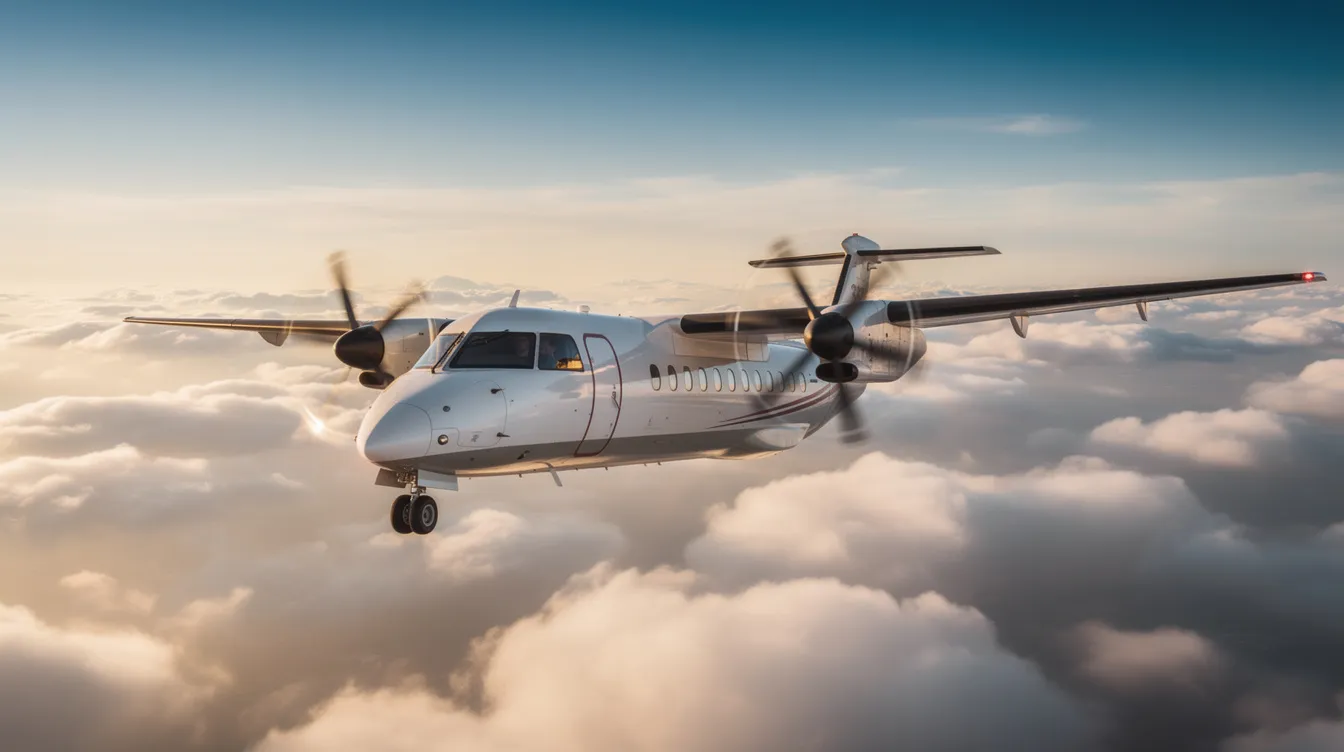
The Piaggio Avanti EVO is one of the most distinctive aircraft in private aviation—a twin turboprop that delivers jet-like speed and a spacious cabin while burning significantly less fuel than many light jets. But for charter customers, the question that matters most is practical: how far can it actually fly on a given trip? This guide breaks down Piaggio Avanti EVO range in real-world terms, covering official specifications, operator planning numbers, route examples, and the factors that move the needle between a non-stop flight and a fuel stop.
The Piaggio Avanti EVO (latest P 180 Avanti generation) combines a top cruise speed of 402 knots with turboprop efficiency, making it one of the fastest propeller-driven aircraft available for charter. This article focuses specifically on its real-world range for charter customers.
Typical Piaggio Avanti EVO range is around 1,350–1,450 nautical miles with four passengers and NBAA IFR reserves. In long-range or increased-fuel configurations, that number can stretch to roughly 1,650–1,720 nm.
Actual range depends on passenger load, baggage weight, weather, and routing. Charter quotes on Jettly always factor in safety reserves and operator performance data before confirming whether a trip works non-stop.
The Avanti EVO can efficiently cover regional and cross-country routes such as New York–Miami, Los Angeles–Denver, or London–Rome in a single hop.
Readers can use Jettly's instant-quote tools, including its private jet charter cost estimator, to see live pricing and suitable aircraft, including the Piaggio P180 Avanti EVO, for their specific route.
The Avanti EVO stands as the third-generation evolution of the Piaggio Avanti family, built by Piaggio Aerospace in Italy, one of several notable private plane manufacturers serving different mission profiles and budgets. Its niche is clear: a high-performance twin turboprop that flies like a light jet but burns roughly 30% to 40% less fuel than comparably sized jets, while delivering comfort and performance that place it alongside some of the best private jets in the world for regional missions. That combination of innovation and Italian style has kept the aircraft relevant in the turboprop market since first EVO deliveries began in mid-2015.
Key facts at a glance:
Powered by two Pratt & Whitney Canada PT6A-66B turboprop engines, each rated at 850 shp
Maximum cruise speed of approximately 402 KTAS—faster than nearly every other civil turboprop
Service ceiling of 41,000 feet, meaning it operates well above commercial air traffic levels
Maximum takeoff weight (MTOW) of 12,100 lbs
Typical seating for six passengers in executive configuration, with a cabin height of 5 ft 9 in and cabin width just over 6 feet
The Avanti EVO features advanced avionics, including the Rockwell Collins Pro Line 21
The aircraft is often called the "Piaggio Avanti," "Piaggio P180," or simply the "Avanti EVO." On Jettly's marketplace, it typically appears within the turboprop or twin turboprop category.
Its unique three-lifting-surface configuration—featuring a forward wing (canard), main wing, and tail—reduces drag and contributes to exceptional speed for a turboprop aircraft. The rear-facing engine configuration with rear-mounted engines further enhances aerodynamic efficiency, giving the aircraft its distinctive design. Understanding these basics helps explain how the Piaggio Avanti EVO achieves its range numbers and why it appeals to cost-conscious charterers.
Range figures for the Piaggio Avanti EVO vary by source, configuration, and assumptions. Here is how "book" numbers compare with realistic charter performance.
The Avanti EVO has a maximum range of 1,470 nautical miles under standard conditions. Depending on configuration—particularly when using optional increased fuel capacity and long-range cruise settings—the range extends to approximately 1,500 to 1,770 nautical miles. The aircraft operates at altitudes up to 41,000 feet, where its aerodynamic design reduces drag and allows for jet-like speeds with lower fuel consumption.
Compared to the earlier Avanti II and original P 180, the EVO's aerodynamic tweaks (five-blade scimitar propellers, updated forward wing, winglets) add roughly 50–200 nm of range depending on loading and cruise settings. That is a meaningful step forward for operators flying longer legs.
Charter operators usually plan more conservatively than brochure specifications suggest. Many treat 1,200–1,300 nm as the comfortable planning range for day-to-day missions, maintaining fuel reserves and operational flexibility for alternates, holding, and weather diversions.
It is important to distinguish "ferry range" (minimal payload, maximum fuel) from "typical charter range" (four to six passengers plus bags). A route that looks marginal on a range map may require a fuel stop once real-world weight and reserves are applied-and that is exactly what a Jettly quote accounts for.
A range map is essentially a visual circle drawn around a base airport, showing how far an aircraft can fly non-stop. Jettly's tools and operator data can approximate a Piaggio Avanti EVO range map from any chosen departure point.

Concrete examples from major regions, described by destination reach:
From New York (TEB/JFK): The aircraft can generally reach Miami (~1,100 nm), Dallas (~1,300 nm), Chicago (~800–900 nm), and parts of Eastern Canada non-stop.
From Los Angeles (VNY/LAX): Typical non-stop reach includes Denver (~830 nm), Seattle (~960 nm), Cabo San Lucas (~1,000–1,100 nm), and most of the US West Coast.
From London (LCY/LTN): The Avanti EVO can normally cover destinations like Rome (~860 nm), Madrid (~650–700 nm), Oslo (~800–900 nm), and Marrakech (~1,100–1,200 nm) in one hop, depending on winds and payload.
Winds aloft, temperature, and runway elevations can shrink or expand this notional range map. Operators always recalculate based on day-of-flight conditions, and tools like Jettly's airport locator help identify suitable departure and destination airports for a given mission.
Because the Piaggio Avanti EVO is optimized for regional missions, its sweet spot is usually flights between 400 and 1,200 nm—where it is both time-efficient and cost-efficient compared with light jets. For routes beyond that, using Jettly's private jet charter cost estimator turns theoretical range maps into concrete trip plans with confirmed feasibility and pricing.
Range is not a fixed number. It fluctuates with aircraft loading, environment, and how the flight is flown. This matters when evaluating a Piaggio Avanti EVO for a specific charter mission.
Payload: More passengers and heavier baggage reduce the fuel that can be carried within weight limits. Moving from two to six adults with luggage can cut several hundred nautical miles from the most optimistic range figures.
Cruise speed and altitude: Flying at maximum speed (~402 KTAS) burns more fuel. Long-range cruise around 300–310 KTAS at higher altitudes yields greater range but adds flight time. Fuel consumption is approximately 118 gallons per hour at normal cruise settings.
Weather and winds: Strong winter headwinds on westbound transcontinental or North Atlantic routes can materially reduce available range. Tailwinds help but are not guaranteed.
Airport characteristics: High-altitude or hot-climate runways (Denver, Mexico City, Dubai) can require performance-limited departures with less fuel. Short-field performance is supported with takeoff distances of approximately 3,260 feet at sea level, and the Piaggio Avanti EVO has shorter published runway requirements than many large jets—but very constrained runways may still force a fuel-load reduction.
Reserves and regulations: IFR planning requires fuel for alternates, holding, and contingency. These safety margins reduce usable range versus maximum published figures.
When a user enters route, date, and passenger count on Jettly, operators incorporate all these elements before confirming whether a new aircraft like the Avanti EVO can operate the trip non-stop.
Many travelers compare the Avanti EVO with aircraft such as the Beechcraft King Air 350i, Pilatus PC-12, and light jets like the Embraer Phenom 100 when deciding what to charter. The Avanti EVO competes with both traditional turboprops and light jets, occupying a unique position in the fleet.
While the Avanti EVO is the fastest civil turboprop—cruising at 402 knots, faster than the King Air 350i—its range is competitive but not class-leading. Here is how key competitors stack up:
King Air 350i: Slower cruise (around 310–320 KTAS) but a greater range of 1,806 nautical miles in certain configurations. Better for long legs where speed matters less than non-stop reach.
Pilatus PC-12: A single-engine turboprop with longer advertised range but lower cruise speed (~260–300 KTAS). Added safety systems like twin-engine redundancy give the Avanti EVO an edge for some operators and owners.
Embraer Phenom 100: A light jet with shorter range than a well-configured Piaggio Avanti EVO and higher fuel burn per hour. The Phenom 100 is priced at $4.2 million, cheaper than the Avanti EVO's list price of $7.4 million—but operating costs per flight hour often favor the turboprop, a dynamic echoed in many cheapest single-pilot jet comparisons where purchase price and ongoing costs must both be weighed.
For many 600–1,000 nm missions, the practical time difference between a Piaggio Avanti EVO and small jets is minimal, while operating costs can favor the turboprop, which is why guides to choosing the best cross-country plane often highlight turboprops for balancing speed, range, and economy. Jettly enables quick comparisons across aircraft classes, so users can weigh range, speed, cabin size, and hourly rate before booking.
Range only matters if passengers are comfortable for the duration. The Piaggio Avanti EVO's cabin design is a key reason it is selected for two- to four-hour regional missions.
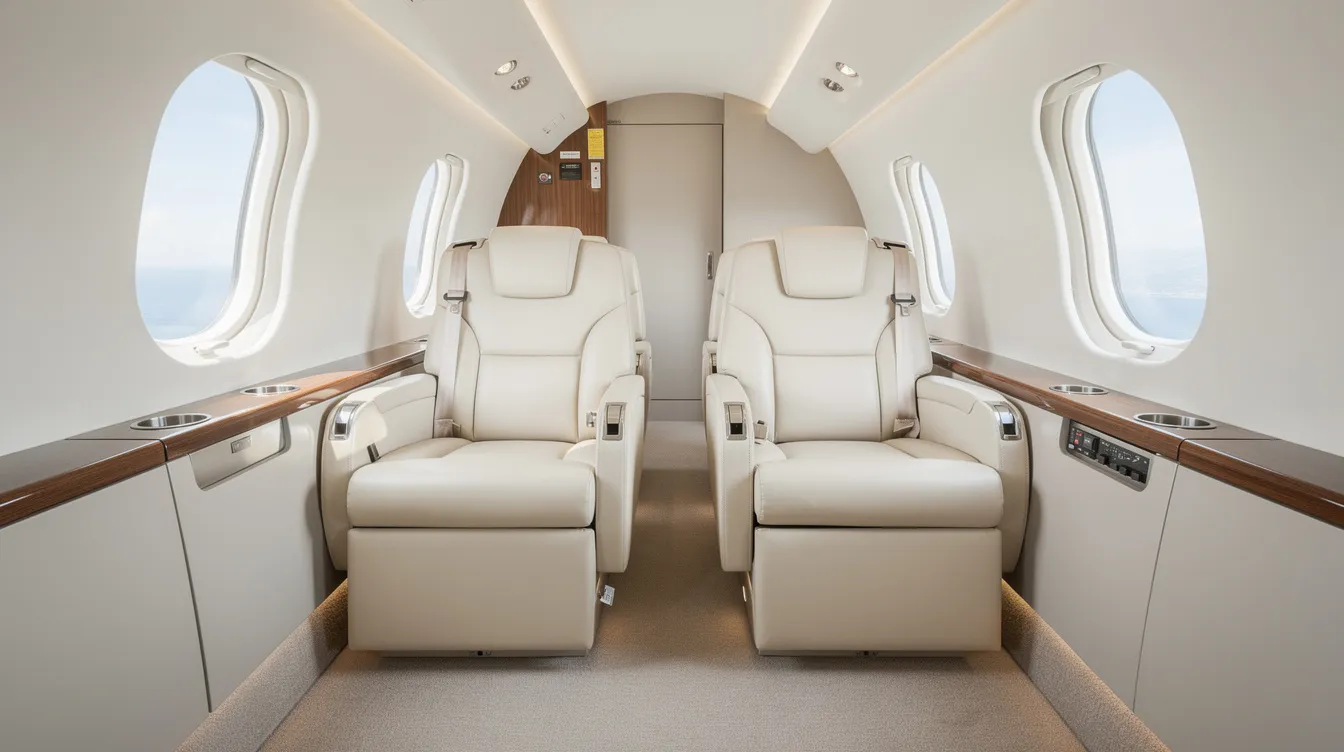
The cabin features:
A flat-floor layout with stand-up height of 5 ft 9 in (cabin height) and cabin width just over 6 feet—spacious compared with many light jets and other turboprops
Seating for up to six passengers in luxurious leather seats, with the cabin accommodating various executive configurations
Fold-out tables and power outlets at every seat, plus a fully enclosed aft lavatory for passenger comfort
Low cabin noise levels thanks to rear-mounted pusher propellers, which push engine noise behind the fuselage and deliver a lower noise footprint than conventional turboprops
Low cabin altitude at high altitudes, which helps minimize fatigue on longer flights—a detail many passengers notice on trips over two hours
The cabin is designed for comfort on flights like Toronto–Atlanta, Paris–Athens, or São Paulo–Buenos Aires, all of which fall well inside the Avanti EVO's range and align with the luxurious cabin experience. On Jettly, users can filter by cabin size and aircraft class to see when a Piaggio Avanti EVO provides the right balance of passenger comfort, cabin space, and range compared with compact light jets or smaller turboprops.
Many Jettly customers look not only at range but also at hourly cost and fuel efficiency when picking between turboprops and jets for regional travel, often consulting guides on affordable private jet charter to understand how pricing works across aircraft types.
The Piaggio Avanti EVO burns approximately 118 gallons of fuel per hour—significantly less than comparable light jets, making it attractive to travelers and owners who prioritize affordable planes and budget-friendly aircraft choices. Its aerodynamic design and turboprop efficiency translate directly into lower operating costs, which is a key consideration in any broader analysis of how much a private jet really costs to own or operate. Published data provides a general overview of ownership economics, including annual fixed costs, variable costs, cost per flight hour at $2,799 based on 350 annual hours, and a total yearly budget of $979,760. Actual prices vary with the aircraft’s condition, configuration, and operating environment.
Its speed allows near-jet block times on legs up to about 1,000–1,200 nm, so travelers achieve similar schedules with lower hourly fuel and engine reserves. This can translate into more competitive charter pricing compared with many jets in a similar class, especially when you understand how much it costs to rent a private jet across different categories.
Ideal use cases include chartering through platforms that provide broad private charter aircraft access, where the Avanti EVO often appears as a sweet-spot turboprop for missions like:
Recurring business hops between regional hubs within a 600–800 nm radius
Same-day out-and-back trips where a faster climb and high cruise speed save meaningful time
Group leisure travel where four to six passengers share the cost
The Piaggio Avanti EVO is a "sweet spot" choice on Jettly when the trip is under roughly 1,300 nm, runway length is moderate, cabin comfort for four to six passengers is required, and the customer wants to keep costs below typical light-jet levels.
Jettly is a charter broker and digital marketplace, connecting travelers to properly certified third-party operators flying aircraft such as the Piaggio Avanti EVO, King Air, and various light jets, with options to fly ad hoc or through private jet memberships that can reduce per-trip costs for frequent users.
Here is how the process works:
Visit jettly.com and enter departure and arrival airports, dates, and passenger count.
Review instant pricing and see which aircraft—including the Piaggio Avanti EVO or other Piaggio P180 variants—can operate the requested sector non-stop.
If the system suggests a fuel stop or a different aircraft category, it reflects real-world safety margins, not arbitrary limitations.
Jettly members can also work with support to compare multiple aircraft for specific missions (for example, Piaggio Avanti EVO versus a light jet versus a larger turboprop) to see how range, total travel time, and total trip cost differ, or use the jet card flight cost estimator to understand pricing on funded jet card programs.
Ready to fly on your terms? Explore live charter options on the relevant quote page and get an instant quote for your next Piaggio Avanti EVO trip or comparable aircraft at https://www.jettly.com.

Below are common, practical questions about using the Piaggio Avanti EVO and P 180 Avanti family on charter flights.
With around four passengers, standard baggage, and IFR fuel reserves, most operators plan for approximately 1,300–1,450 nautical miles of non-stop range in normal conditions. In optimal circumstances—light payload, long-range cruise, favorable winds—some operators can stretch to about 1,600+ nm. Jettly quotes always default to conservative, safety-first planning.
The Piaggio Avanti EVO is primarily a regional aircraft. US coast-to-coast routes like New York–Los Angeles or Boston–San Francisco will normally require at least one fuel stop. Transatlantic crossings (for example, New York–London) are outside its practical charter range, so Jettly would typically recommend a larger jet with oceanic certification for those missions.
The P 180 Avanti series has solid short-field performance, needing roughly 3,200–3,300 feet for takeoff at sea level in standard conditions. It also features anti-skid brakes for safer operation on shorter strips. However, very short or high-altitude runways may force operators to reduce fuel load, shortening range. Enter your preferred smaller airport into Jettly's search so operators can confirm runway suitability and expected non-stop range.
Increasing from two to six passengers plus luggage adds significant weight, which generally reduces maximum non-stop range—often by a few hundred nautical miles compared with the most optimistic brochure figures. This is why Jettly's charter quotes ask for passenger count and baggage details, allowing more accurate, aircraft-specific estimates.
Visit https://www.jettly.com, input departure and arrival airports, date, time, and passenger number, then review the list of available aircraft filtered by suitability and operator availability. If a Piaggio Avanti EVO does not appear, contact Jettly support or adjust timing and routing—availability depends on where suitable P 180 Avanti aircraft are based and how they are scheduled. Watch for updated fleet options as operators add new aircraft to the platform.
The Piaggio Avanti EVO range makes the aircraft a strong option for regional trips, especially when four to six passengers want jet-like speed, a roomy cabin, and lower fuel consumption than many light jets. In typical charter conditions, plan around 1,350–1,450 nautical miles, while the actual nonstop distance depends on passenger and baggage weight, weather, runway conditions, and required reserves. For longer routes, operators may recommend a fuel stop or a different aircraft.
Jettly helps travelers compare the Avanti EVO with other available aircraft and review route-specific pricing before booking, positioning itself as a flexible NetJets alternative for those who prefer on-demand charter and memberships over fractional ownership. Jettly is a charter broker; flights are operated by properly certified third-party carriers. Explore aircraft options and request an instant quote at https://www.jettly.com.
Share this post:
Jay Franco Serevilla
Nov 15, 2026
|
5
min read
Discover tips and trends in the industry.

5
min read
Flight Time From NY to London: What to Expect on Commercial and Private Jets
The flight time from New York to London typically ranges from 6.5 to 7.5 hours for commercial flights, while private jets can complete the journey in about 6 to 7 hours. Factors such as jet stream conditions, airport choice, and aircraft type significantly influence travel times. This guide provides insights into optimizing your trip, whether flying commercially or privately.
Read More
5
min read
How Far in Advance Should I Book a Flight? (Private & Commercial)
Understanding how far in advance to book a flight is crucial for travelers. For commercial flights, the ideal booking window is typically 1 to 3 months ahead, while private jet charters can often be arranged closer to departure. Factors like destination, seasonality, and route type significantly influence the best time to secure your tickets.
Read MoreStay updated with our latest insights and tips to elevate your journey with us.
MEMBERSHIPS AND ASSOCIATIONS



© 2026 Jettly Inc. All rights reserved.
Disclaimer: Jettly operates as a charter broker, offering access to a global digital jet charter marketplace. Jettly is not a direct air carrier and does not own or operate aircraft. All advertised flights are conducted by third-party air carriers that are fully licensed and hold the appropriate Part 135 or Part 121 certifications issued by the Federal Aviation Administration (FAA) or equivalent regulatory authorities under U.S. or foreign law. Jettly complies fully with the U.S. Department of Transportation's Part 295 and Part 298 Charter Broker regulations. Jettly does not carry additional liability insurance. Passengers are covered by aircraft operator insurance. TICO: 50023770


