



Login
Get Instant Pricing On 23,000+ Aircraft

>
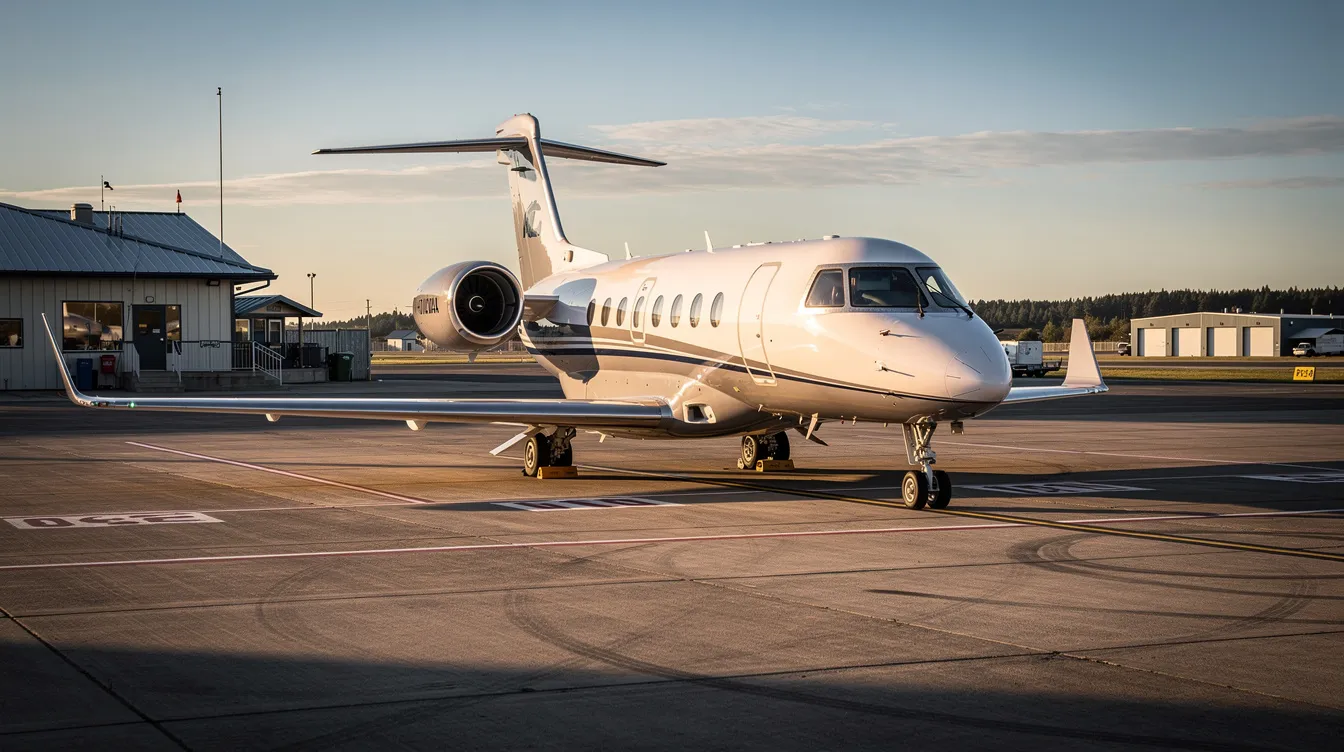
Choosing the right private jet starts with one practical question: how many seats do you actually need? Whether chartering for a business meeting or a family trip, understanding private jet seating capacity helps travelers avoid overspending on a bigger aircraft or cramming into one that's too small. This guide breaks down seat counts by aircraft class, highlights popular models, and shows how to match passenger count to the right plane.
Most private jets seat between 4 and 19 passengers. Very light jets offer 4–5 seats, light jets 6–8, midsize jets 7–9, super-midsize 8–10, and large cabin business jets 12–19. VIP airliners push that to 20–30+ seats.
Regulatory limits cap charter operations at 19 passenger seats under FAA Part 135 rules.
The most common private jets accommodate approximately 6 to 12 passengers, covering the bulk of on-demand charter bookings.
Passenger capacity varies by aircraft category and cabin layout - not just by model name. Distance, luggage volume, and runway length all shape the final passenger count.
Popular examples include the Embraer Phenom 300 (up to 8 seats), Citation XLS+ (up to 9), Gulfstream G550 (up to 18), and Boeing Business Jet 737 variants (20–30+).
Right-sizing the aircraft improves comfort, keeps costs in check, and reduces environmental impact. Jettly's instant-quote tools help travelers match seat count to each trip.
Most private jets seat between 4 and 19 passengers, with some VIP airliners and 30-seat private jet options available for larger groups. Regulatory limits cap charter operations at 19 passenger seats under FAA Part 135 rules. Here is a quick breakdown by class:
|
Aircraft category |
Typical passenger seats |
Best suited for |
|---|---|---|
|
Very light jet |
4–7 |
Short regional trips and small groups |
|
Light jet |
5–8 |
Short- to medium-haul business or leisure travel |
|
Midsize jet |
7–10 |
Medium-distance trips with added cabin and baggage space |
|
Super-midsize jet |
8–10 |
Longer routes and coast-to-coast travel |
|
Heavy jet |
10–16+ |
Larger groups and long-range flights |
|
Ultra-long-range jet |
Up to 19 |
Intercontinental and overnight trips |
|
VIP airliner / bizliner |
20–50+ |
Corporate shuttles and large group charters |
How many passengers fit on a specific charter depends on both the certified maximum seats and the chosen interior layout. Private jets offer flexible cabin layouts including club seating and convertible beds, so two aircraft of the same model can carry different totals.
Private jets can access over 5,000 airports worldwide, compared to the roughly 1,000 airports commercial airlines typically serve. That flexibility extends to seating: on Jettly, most on-demand charters are booked in aircraft carrying 4–12 passengers, while larger cabins and Boeing 737 VIP-style jets handle corporate or group missions. Travelers can check exact seating capacity and floorplans through Jettly's instant pricing and aircraft comparison tools.
Jettly customers typically encounter six private jet size categories: very light jets, light jets, midsize jets, super-midsize jets, heavy jets and large cabin aircraft, and VIP airliners (bizliners), similar to the range of operators you’ll see in a broad charter airlines and private jet guide. Each aircraft type balances seat count, range, and overall comfort differently.
Private jet capacity depends on type and layout. Within each class, interior configurations vary - some private aircraft sacrifice one or two seats for extra divans, workspaces, or luggage room. That means travelers should consider both "how many seats" and "how far" when choosing.
Indicative mission types by class:
Day trips and regional hops: very light and light jets
Coast-to-coast flights: midsize and super-midsize jets
Intercontinental flights and overnight trips: heavy jets and ultra-long-range models
Large group or special missions: VIP airliners
Jettly's platform groups aircraft into these categories to simplify selection and pricing comparisons for travelers who aren't aviation experts, much like wider market overviews of the best private jet charter companies help newcomers understand their options.
Very light jets and compact light jets are the smallest business jets, optimized for flights of one to three hours and small groups or families. Very light jets typically accommodate 4 to 5 passengers, while light jets typically accommodate 6 to 8 passengers, with limited standing headroom.
Specific models and seating:
HondaJet Elite II: 4–5 seats
Eclipse 550: 4 seats
Embraer Phenom 100: 4–5 seats
Embraer Phenom 300: accommodates up to eight passengers
Citation CJ3+: 6–7 seats
Cabin style on these jets tends toward a club-four layout, a compact galley, and a single enclosed lavatory (if one is present at all). There is usually no dedicated flight attendant on board. The compact size means cabin height sits around 4.9–5.6 feet, so standing room is tight.
This category is ideal for quick business meetings between cities, regional leisure trips, or cost-effective charters where passengers accept tighter cabin space. Private jet travel reduces ground time significantly compared to commercial flights, making even a four-seat very light jet a time-saver for business travelers flying into smaller airports or using Jettly's airport locator tool to access more convenient airfields.
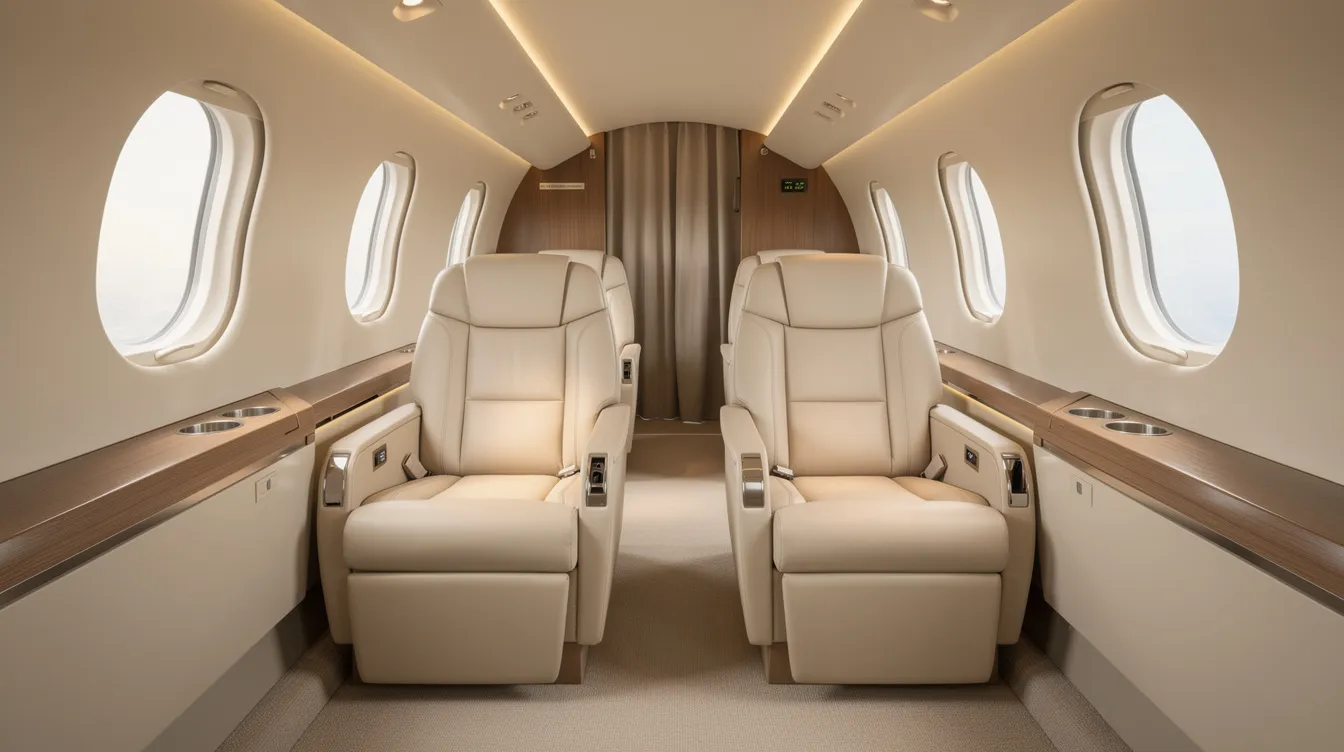
Midsize jets bridge the gap between light jets and heavy jets. Many models offer stand-up cabins, and super-midsize types deliver true coast-to-coast capability. Midsize jets typically accommodate 7 to 9 passengers. Super-midsize jets typically accommodate 8 to 10 passengers, sometimes 11 in high-density layouts.
Key models:
Citation XLS+: can comfortably seat nine passengers (certified up to 12 in high-density config)
Citation Latitude: 8–9 seats
Praetor 500: 7–9 seats
Gulfstream G280: 8–10 seats
Bombardier Challenger 3500: 8–10 seats
Cabin zones on these jets typically include a forward club-four, an aft divan or conference grouping, an enclosed lavatory, and better baggage volume than light jets. Private jets offer personalized in-flight services tailored to passengers, and midsize jets are where those amenities - full refreshment service, ample space for laptops, and partial galleys - start to feel genuinely comfortable.
Ideal use cases: 4–7 passengers flying New York to Dallas, Los Angeles to Chicago, or Toronto to Vancouver, wanting more space and luggage room without stepping up to a full large cabin jet.
Heavy jets and large cabin business jets are long-range aircraft with full stand-up cabins, multiple living areas, and typical seating for 12–19 passengers. Heavy jets typically accommodate 10 to 16 passengers, while ultra-long-range jets can carry up to 19 passengers.
Models and seat counts:
Gulfstream G550: has a seating capacity of 18 passengers in certain configurations. The Gulfstream G550 accommodates up to 18 passengers.
Gulfstream G650ER / G700: up to 19 seats
Bombardier Global 7500 / Global 8000: up to 19 seats
Dassault Falcon 7X / Falcon 8X: 12–16 seats (certified for up to 19)
Dassault Falcon 10X: planned for up to 19 seats
Typical layouts include separate zones for work, dining, and rest. Lie-flat seating or convertible beds, a large galley, one or two lavatories, and a dedicated flight attendant are standard on longer routes. While these jets can be certified for the upper end of their seat range, many operators configure them for fewer passengers to maximize comfort.
Range affects passenger capacity due to fuel storage needs - on the longest sectors, payload trade-offs may reduce available seating or baggage. Private jets can fly non-stop for distances over 8,000 nautical miles on some of these heavy jet platforms. Jettly customers often book larger jets for overnight transatlantic flights, corporate roadshows, and multi-leg itineraries with 8–14 travelers.
VIP airliners - sometimes called bizliners - are converted commercial airliners such as Airbus Corporate Jets (ACJ) and Boeing Business Jets (BBJ), including Boeing 737 variants. These wide-body aircraft offer a travel experience closer to a private flying hotel than a traditional private plane.
VIP airliners can carry 19 to 50+ passengers depending on configuration, with 25–30 seats being common for corporate shuttles and government use. Specific types include:
Airbus ACJ320neo: 20–30 seats in VIP layout
Boeing 737 BBJ: 20–30+ seats, sometimes up to 40
Boeing 747-8 BBJ: carries up to 75 passengers in certain configurations
ACJ350 XWB: accommodates 25 passengers in a typical executive layout
Embraer Lineage 1000E: 13–19 seats configured for luxury
Larger VIP airliners can accommodate 30 to 50 passengers or more, depending on layout. These 30-seat private jet charters suit sports teams, incentive trips, product launches, or diplomatic delegations that want private control of a bigger aircraft, and some travelers use flight sharing and empty-seat platforms to make these large-cabin options more cost-effective. For more detail on Boeing 737 seat capacity, Jettly's blog covers each variant.
While Jettly's core inventory ranges from 4–19 seats, the platform can source VIP airliners via its extended operator network for group charters.
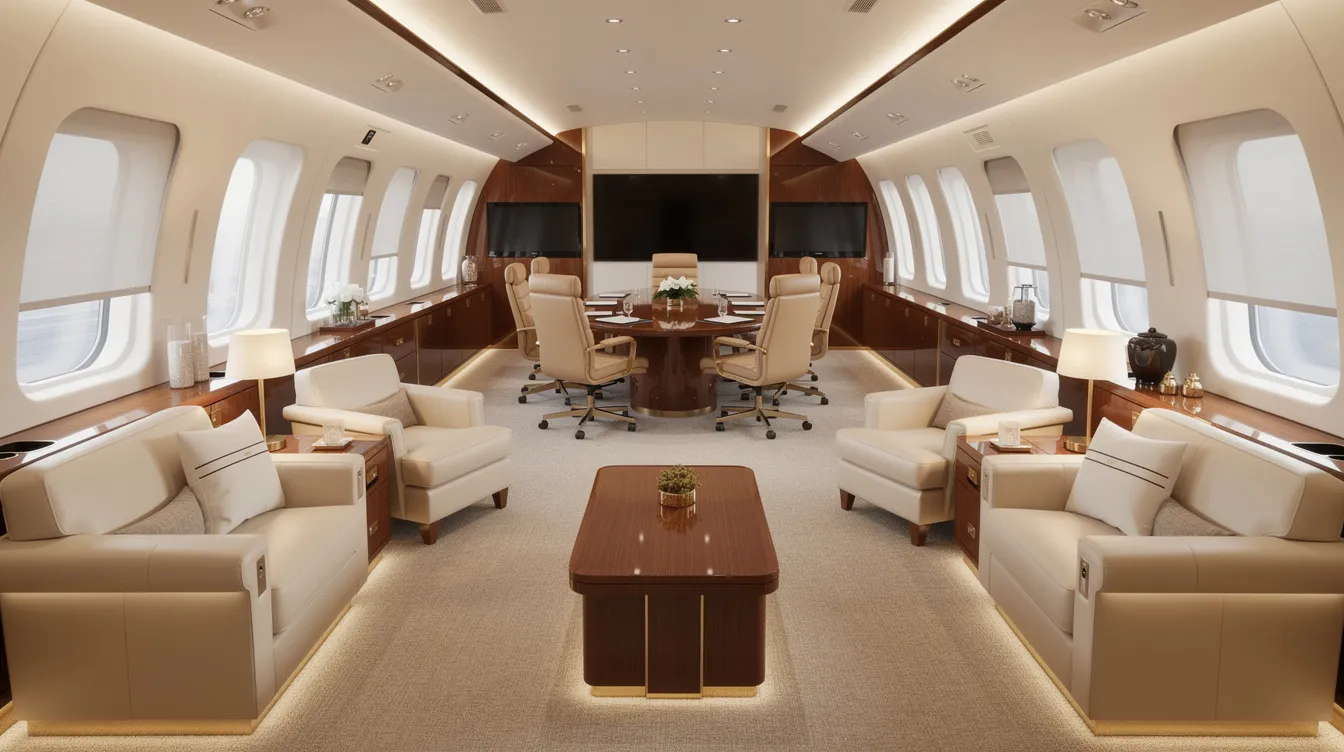
Certified maximum seats are only one part of the story. Real charter passenger count also depends on several operational factors:
Cabin configuration: Divans, conference rooms, extra wardrobes, or larger galleys reduce seat count. Cabin customization affects both passenger capacity and available sleeping arrangements. Cabin configuration influences overall comfort and seating capacity.
Range and fuel: Longer sectors on business jets like the Bombardier Global or Dassault Falcon may require payload trade-offs, occasionally reducing available seating or baggage; Jettly's private charter aircraft inventory spans multiple classes so travelers can balance range, payload, and cabin size.
Weight and balance: Passenger weight, luggage, catering, and optional equipment affect how many people can be carried, especially from shorter runways or hot-and-high airports. Weight and comfort preferences impact total passenger count. Jet capacity can be limited by factors like fuel load and payload limits.
Belted lavatories: Belted lavatories contribute to maximum passenger capacity in some jets, allowing an extra certified seat in the lavatory area.
Regulatory limits: Regulatory limits cap charter operations at 19 passenger seats under FAA Part 135 rules. Operators may impose lower internal limits than the aircraft's absolute certification allows.
Maximum vs. comfortable: Maximum certified seating does not guarantee comfortable arrangements for passengers. Many operators intentionally cap passengers below the legal maximum.
Seated capacity does not always equal sleeping capacity - a jet with 14 seats may only convert six of them into lie-flat beds. For a deeper dive into how aircraft weight shapes performance and comfort, see Jettly's guide on the weight of a private jet.
Here is a quick reference mapping aircraft size classes to specific models, typical seating, and approximate range:
Light jets:
Embraer Phenom 300: 6–8 seats, ~1,800 nm range
Citation CJ3+: 6–7 seats, ~1,900 nm range
Hawker 400XP: 7–8 seats, ~1,500 nm range
Mid-size jets:
Citation XLS+: 7–9 seats, ~2,100 nm range
Citation Latitude: 8–9 seats, ~2,700 nm range
Learjet 60: 7–8 seats, ~2,400 nm range
Super-midsize and heavy jets:
Bombardier Challenger 350: 8–10 seats, ~3,200 nm range
Gulfstream G280: 8–10 seats, ~3,600 nm range
Gulfstream G550: up to 18 seats, ~6,750 nm range
Dassault Falcon 900: 12–14 seats, ~4,000 nm range
VIP airliners:
Boeing Business Jet 737: 20–30 seats in VIP layout
Airbus Corporate Jets ACJ320neo: 20–30 seats in VIP layout
For a full breakdown across all private jet types and sizes, Jettly's comparison guides cover range, baggage, and pricing side by side, and a dedicated guide on how many passengers each jet type can carry helps refine your seat-count decision.
Seat count alone does not reflect comfort. Aircraft size matters, but cabin height, width, and seating layout shape the onboard experience just as much. Common seating arrangements include:
Four-seat club configurations facing each other
Forward and aft lounges separated by dividers for privacy
Convertible seating that turns into beds on long-haul flights
Conference rooms with fixed tables for working groups
Features like movable tables, power outlets, high-speed Wi-Fi, entertainment systems, and tailored in-flight catering for private jets support work or relaxation regardless of how many passengers are on board. Some large cabin business jets and heavy jets are configured with fewer seats than possible to provide ample seating with wide personal space and dedicated sleeping areas - features that prioritize rest over passenger capacity.
Through Jettly, travelers can review interior photos and floorplans, and request specific seating layout or cabin arrangements where operators allow customization.
Larger jets and VIP airliners burn more fuel per hour, but may offer competitive per-seat cost and lower environmental impact per passenger when fully occupied. Light jets and mid-size jets are more fuel efficient for small groups of 2–6 travelers, while large cabin or heavy jets make financial sense when 8–14 people share the aircraft; understanding private jet charter costs and ways to save can help right-size both your budget and your aircraft choice.
Per-seat emissions shift meaningfully with occupancy. A heavy jet carrying two passengers has a far higher carbon footprint per person than the same plane carrying twelve. Right-sizing the aircraft - choosing the smallest jet that meets the mission - improves fuel efficiency and reduces waste.
Newer models incorporate advanced technology and fuel-efficient engines. Aircraft like the Bombardier Global 7500, Dassault Falcon 8X, and Boeing Business Jet MAX variants use modern aerodynamics to extend range while cutting fuel burn. Jettly encourages informed decisions, offers carbon offset options where available, and helps travelers compare charter pricing or use a jet card flight cost estimator across more efficient aircraft when environmental impact is a decision factor.
A clear decision path starts with four variables: passenger count, distance, luggage volume, and preferred airport access. From there, onboard amenities and budget refine the choice.
Practical examples:
4 colleagues on a 500-mile day trip → a light jet like the Phenom 300
7 family members crossing the country → a mid-size or super-midsize jet like the Bombardier Challenger 3500
14 executives on a Europe-to-US run → a large cabin business jet like the Gulfstream G650ER
Jettly's digital platform uses these variables to surface suitable aircraft options, displaying seat counts, cabin photos, and pricing side by side, while private jet memberships give frequent flyers predictable access and wholesale-style rates. As a charter broker, Jettly arranges flights operated by certified third-party air carriers. Safety, operator ratings, and regulatory compliance are built into every aircraft selection, and structured jet card programs can further streamline planning for repeat travelers with consistent seat-count needs.
Ready to explore your next flight? Check real aircraft and ample seating options for your dates and routes at https://www.jettly.com or book directly through partners like Dexter Air Taxi’s private jet service powered by Jettly.

These FAQs address common seat-related questions not fully covered above. Answers are kept practical and focused on charter decision-making.
Most charter cabins have fixed seat installations. Operators seldom add new seats, but some can remove or block seats - such as removing a divan cushion or leaving a seat unused - to create more space. Any changes must comply with certification and safety rules. Travelers should request special layouts well in advance and confirm feasibility through Jettly.
There is usually no minimum passenger requirement. A single traveler can charter a 7-seat light jet or a 14-seat large cabin jet, paying for the aircraft rather than per-seat tickets. Customers can share costs within their group to lower the effective per-passenger price when booking bigger aircraft, or explore buying just a seat on a private jet through shared and semi-private options.
From a safety and regulatory standpoint, infants and children are usually counted when determining maximum occupancy. Specific rules apply for restraint systems and seating positions. Parents should discuss ages and special needs with Jettly during quoting so operators can plan appropriate seating and safety equipment.
Small changes - for example, 5 to 6 passengers - often fit within the same aircraft as long as capacity and weight limits are respected. Larger changes may require re-quoting a different jet size. Notify Jettly as early as possible about passenger count changes to avoid performance, luggage, or weather conditions issues on the day of departure.
Hourly rates increase with aircraft size. Light jets are typically cheaper per hour than mid-size jets, which are in turn cheaper than heavy jets or Boeing 737 BBJ-style VIP airliners. However, when more passengers share the cost on a larger jet, the per-person expense can sometimes match or beat premium commercial airliners' tickets, especially if you use strategies for getting a private jet seat easily and affordably.
Jettly's instant pricing lets travelers compare these trade-offs directly for longer routes and busy airports, positioning the platform as a flexible NetJets alternative for flying private without long-term commitments.
Private jet seating ranges from 4 to around 19 seats for most business jets, with 20–30+ seat VIP airliners and Boeing 737-based BBJs available for special group missions. Aircraft size, seat configuration, and mission profile all influence how many passengers an aircraft can carry comfortably - not just the maximum technical passenger count.
Jettly's platform helps travelers align passenger numbers, distance, luggage, and budget with the right jet class, from compact light jets to large cabin and VIP airliners. Whether you need to fly a first flight for a small team or accommodate a full delegation, the right private jet is a search away.
Ready to experience private travel on your terms? Explore flight options or request an instant charter quote at https://www.jettly.com.
Share this post:
Jay Franco Serevilla
Nov 25, 2026
|
5
min read
Discover tips and trends in the industry.
5
min read
What Is Private Jet? A Practical Guide to Private Flights
A private jet is a chartered aircraft that provides on-demand travel for individuals or groups, offering flexibility and privacy. This guide covers the types of private jets, how to book them, and the benefits of flying privately, making it ideal for both newcomers and seasoned travelers. With platforms like Jettly, accessing over 20,000 aircraft worldwide has never been easier.
Read More5
min read
Private Jet: How Many Seats Do You Really Need?
Choosing the right private jet begins with understanding how many seats you need. This guide outlines seating capacities across various jet categories, helping travelers select the ideal aircraft for their journey while avoiding unnecessary costs. From very light jets to VIP airliners, knowing your passenger count ensures comfort and efficiency.
Read MoreStay updated with our latest insights and tips to elevate your journey with us.
MEMBERSHIPS AND ASSOCIATIONS



© 2026 Jettly Inc. All rights reserved.
Disclaimer: Jettly operates as a charter broker, offering access to a global digital jet charter marketplace. Jettly is not a direct air carrier and does not own or operate aircraft. All advertised flights are conducted by third-party air carriers that are fully licensed and hold the appropriate Part 135 or Part 121 certifications issued by the Federal Aviation Administration (FAA) or equivalent regulatory authorities under U.S. or foreign law. Jettly complies fully with the U.S. Department of Transportation's Part 295 and Part 298 Charter Broker regulations. Jettly does not carry additional liability insurance. Passengers are covered by aircraft operator insurance. TICO: 50023770


