



Login
Get Instant Pricing On 23,000+ Aircraft

>

The Boeing 777-200ER remains one of the most recognized long-haul commercial aircraft ever built. Its published range, real-world performance, and the routes it serves shape how millions of travelers cross oceans and continents every year. But how far can it actually fly—and when does a private charter make more sense? This guide breaks down the 777-200ER range in practical terms, compares it to other airliners and private jets, and shows how travelers can use that knowledge to plan smarter trips.
The Boeing 777-200ER is the extended range version of the baseline Boeing 777-200. Under ideal conditions, the 777-200ER has a range of 7,725 nautical miles (about 14,305 km), though actual mission range depends heavily on load, weather, and configuration.
The 777-200ER range allows nonstop routes such as London–Tokyo, New York–Johannesburg, and Los Angeles–Sydney. Airlines like British Airways, United Airlines, American Airlines, and Pakistan International Airlines have all deployed it on these kinds of missions.
Published brochure range figures assume favorable conditions—light payload, minimal headwinds, full fuel. In real-world airline service, effective nonstop range typically falls between 6,500 and 7,300 nautical miles once fuel reserves, weather, and regulatory margins are factored in.
Private long-range jets such as the Gulfstream G650ER (~7,500 nmi) and the Bombardier Global 7500 (~7,700 nmi) can match or exceed many 777-200ER routes, while offering flexible scheduling, direct routing, and fully private cabins for smaller groups.
Travelers can use Jettly's instant-quote tools and airport locator tool to compare commercial 777-200ER routes with custom private charter options at jettly.com.
The "ER" in 777-200ER stands for Extended Range. This variant of the Boeing 777 was designed from the outset to push nonstop capability far beyond the baseline model, targeting direct transcontinental and transoceanic service between major global hubs. The 777-200ER entered service on February 9, 1997, with British Airways as a launch operator, and quickly became a fixture on long-haul routes worldwide.
The headline range figure: up to about 7,725 nautical miles (14,305 km) under typical manufacturer assumptions, cruising near Mach 0.84 at altitudes between FL350 and FL400. This placed the 777-200ER among the premier long-haul airliners of the late 1990s and 2000s, enabling transpacific, transatlantic, and intercontinental routes that previously required four-engine aircraft or multi-stop itineraries.
Boeing delivered 422 units of the 777-200ER by 2019, with operators spanning every major region. British Airways, United Airlines, American Airlines, Pakistan International Airlines, Japan Airlines, All Nippon Airways (commonly referred to as Nippon Airways in industry shorthand), Singapore Airlines, Qatar Airways, Delta Air Lines, and China Airlines all operated the type at various points. The aircraft's advanced flight control technologies, including fly-by-wire systems and a glass cockpit, represented a significant step forward from previous Boeing models in the widebody category.

The 777 program itself traces back to the late 1980s, when Boeing unveiled proposals to fill the gap between the 767 and the 747. Flight International reported on early development milestones, and eight major airlines contributed to the design process. The Japan Aircraft Development Corporation, representing Japanese aerospace contractors, played a significant role in manufacturing individual aircraft components for the airframe. Chief test pilot John Cashman led the flight test program that brought the original 777 to certification.
Official range figures are performance estimates based on standardized assumptions: full fuel, a specified passenger count, standard reserves, and no-wind conditions. Manufacturers typically design aircraft range figures around these baselines.
Key technical factors driving range include fuel capacity, engine-specific fuel consumption, cruise speed and altitude, aerodynamic efficiency, and maximum takeoff weight (MTOW).
Regulatory fuel reserves, alternate airport planning, and route restrictions—such as ETOPS rules over oceans—reduce the usable "commercial" range versus the brochure figure. Airlines must carry contingency fuel, alternate fuel, and holding fuel beyond what the mission itself requires.
Still-air range (no wind) is the baseline metric. Real-world performance changes significantly with headwinds or tailwinds. A strong jet stream on a westbound North Atlantic crossing can reduce effective range by hundreds of nautical miles compared to the same route flown eastbound.
Aircraft manufacturers publish payload-range charts showing how range decreases as payload increases. These charts are the primary dispatch planning tool for airline operations teams.
The baseline Boeing 777-200 and the 777-200ER share the same external dimensions and general appearance, but they differ substantially in fuel capacity, structural weight limits, and range capability. Both are part of Boeing Commercial Airplanes' "typical" 777 family, yet the ER was engineered for a different mission profile.
The Boeing 777-200 has a range of 5,240 nautical miles (~9,700 km). The 777-200ER pushes that to approximately 7,725 nautical miles (~14,305 km) —a jump of nearly 2,500 nmi.
The 777-200ER has a higher MTOW of around 297,550 kg (656,000 pounds) compared to roughly 247,200 kg for the standard 777-200. This additional structural allowance supports more fuel and payload on longer missions.
The Boeing 777-200ER features increased fuel capacity compared to the baseline model, with optional auxiliary fuel tanks and fuel tanks derived from the original wing design adding to overall endurance. This increased fuel capacity permits the aircraft to cover routes that the standard 777-200 simply cannot reach nonstop.
The first commercial flight of the 777-200 took place on June 7, 1995, with United Airlines. The ER variant followed about 18 months later. Boeing announced plans for the ER early in the program as airline customers signaled demand for longer nonstop sectors.
Airlines tend to use the 777-200 on dense, medium- to long-haul routes and domestic and regional operations where range is not the binding constraint. The 777-200ER is reserved for missions where nonstop service across oceans or continents is commercially valuable.
The ER also features a redesigned main landing gear (sometimes described as a modified main landing gear) to handle the higher operating weights.
From a passenger perspective, cabin experience is similar between both variants. But route length and flight time differ markedly—a 7-hour transatlantic hop on a 777-200 versus a 14–15 hour transpacific crossing on a 777-200ER is a fundamentally different travel experience.
Long range depends on the balance between structural limits (MTOW), fuel volume, and payload. The 777-200ER's range advantage over the base model comes directly from its ability to carry more fuel at a higher gross weight without compromising safety margins.
The 777-200ER's fuel capacity is approximately 171,176 US gallons (~45,220 liters), depending on configuration. This is a substantial increase over the baseline 777-200 and is the single largest driver of its extended range capability.
Its maximum takeoff weight of 656,000 pounds (297,550 kg) allows the aircraft to depart with full fuel tanks plus a commercially useful payload—typically 250–320 passengers and belly cargo—while still meeting regulatory performance margins for climb gradient, obstacle clearance, and runway length.
On shorter routes, airlines may carry less fuel ("tankering") to save weight and improve per-flight economics. This does not change the aircraft's maximum range but reduces operating cost on segments well within its capability.
The 777-200ER can carry substantial cargo alongside passengers due to its large interior space and generous lower-deck cargo holds. On the longest routes, however, cargo volume may be restricted to keep total weight below MTOW.
Private long-range jets achieve similar or greater range with far less MTOW by combining advanced aerodynamics, smaller cabins, and fewer passengers. A Bombardier Global 7500 weighs a fraction of a 777-200ER at takeoff yet covers comparable distances. For more on how private jet range works across different aircraft categories, and how major private plane manufacturers design for long-range missions, Jettly's guides break down the specifics.
The 777-200ER can be equipped with three major engine families: General Electric GE90, Pratt & Whitney PW4000, and Rolls-Royce Trent 800. Each engine-aircraft combination was certified through a process of simultaneous airworthiness certification, earning both FAA and JAA certification.
These engines deliver thrust in the 84,000–98,000 lbf range. The 777-200ER is powered by engines with up to 98,000 lbf thrust in higher-rated configurations, making each a powerful jet engine optimized for long-haul cruise at high altitude.
Specific fuel consumption varies modestly between engine types. While the official brochure range remains similar regardless of engine choice, real-world fuel burn, maintenance costs, and range margins can differ. Pakistan International Airlines, for example, operates its 777-200ER fleet with GE90 engines.
Later performance improvement packages—aerodynamic tweaks such as a blade-shaped tail cone, engine software updates, and weight-saving measures—allowed some operators to reduce fuel burn by several percentage points. This effectively increases practical range or payload on certain routes.
The relationship between engine choice and seat fuel efficiency matters for airlines evaluating per-passenger economics on ultra-long sectors. Newer engine variants and maintenance practices have incrementally improved the 777-200ER's operational efficiency since its introduction.
Airlines deploy the 777-200ER primarily on intercontinental routes where nonstop reach is a competitive advantage. Commercial 777-200 flights serve high-volume routes efficiently, linking the world's major business and population centers without intermediate stops.
Historically served routes include London Heathrow–Tokyo Narita, London–Hong Kong, New York–São Paulo, Chicago–Frankfurt, and Los Angeles–Sydney. Major routes include London–New York and Los Angeles–Tokyo in various 777 family configurations.
The 777-200 is used for transatlantic and transpacific flights across dozens of city pairs. Airlines match aircraft range capability with market demand, balancing seat count, cargo revenue, and flight time when assigning 777-200ERs to specific missions.
Pakistan International Airlines has operated a fleet of six 777-200ERs, deploying them on routes such as Islamabad–London, Karachi–Toronto, and long sectors to the Middle East and Europe. PIA was notably among the first airlines to hold all three Boeing 777 long-range variants.
United Airlines and British Airways have employed the 777-200ER on flagship transatlantic and transpacific flights connecting hubs like London Heathrow, Chicago O'Hare, Newark, and San Francisco. Delta Air Lines, Singapore Airlines, and Qatar Airways have also operated the type on similarly demanding sectors.
The aircraft's range was designed to provide direct transcontinental and transoceanic service, reducing the need for the intermediate stops that older, shorter-range twin-engine airliners required.
Passengers often confuse advertised maximum range with the distances airlines reliably fly day to day. The gap between the two is significant and worth understanding for anyone planning long-haul travel.
Main reasons real-world range falls below brochure figures: strong headwinds, required fuel reserves, alternate airport planning, air traffic routing inefficiencies, and higher payload weights.
A theoretical 7,725 nmi capability might translate into a maximum range of approximately 7,065 to 7,500 nautical miles under typical airline planning, and practical nonstop routes often land in the 6,500–7,200 nmi band.
Airlines may limit payload-restricting cargo or even cap passenger count on the longest sectors to preserve nonstop performance within safety and regulatory limits.
Seasonal variation matters. Winter jet-stream headwinds over the North Atlantic or North Pacific can reduce effective westbound range by hundreds of miles compared to summer conditions.
Long-range business jets available through charter platforms are dispatched with customized fuel and payload planning for each mission, often offering more flexibility in departure timing to avoid unfavorable weather patterns, and a wide range of private charter aircraft types to choose from.
"Payload-range" is the core planning tool for airline dispatch teams. It determines how far the aircraft can fly with a given mix of passengers and cargo, and it sets hard limits on what's operationally feasible.
A fully booked 777-200ER with heavy belly cargo may see its effective range reduced by several hundred nautical miles, especially on hot days or from high-altitude airports where takeoff performance is constrained.
Airlines regularly trade off cargo volume, passenger seats, or even impose baggage limits on the very longest routes to keep them reliably nonstop instead of adding a fuel stop.
A practical example: a long westbound flight from Europe to the US West Coast facing strong headwinds might depart slightly lighter on cargo to avoid a technical stop for refueling. The airplane's range is not unlimited, and dispatch teams model these scenarios before every departure.
On shorter sectors well within range, the same aircraft can carry full passengers plus maximum belly cargo, generating additional revenue.
Private charter flights booked via Jettly typically carry fewer passengers and more flexible baggage loads, making it easier to maintain long range without such trade-offs. For intercontinental private jets, payload-range trade-offs are far less restrictive because the cabin holds a fraction of the people.
The Boeing 777 family was among the first large twin jets to earn Extended-range Twin-engine Operational Performance Standards (ETOPS) certification, a milestone that reshaped how twin-engine airliners could be deployed on oceanic routes. ETOPS certification allows the Boeing 777-200ER to operate long overwater flights that were once the exclusive domain of quad jet aircraft.
Early 777s achieved ETOPS-180 approval, meaning the aircraft could fly routes up to 180 minutes from a suitable diversion airport. Later, some operators received extended approvals (ETOPS-207 and beyond), further broadening routing options.
ETOPS does not change raw fuel range, but it broadens the set of viable great-circle paths—especially across the North Atlantic, North Pacific, and Indian Ocean. More direct routing means less fuel burned on detours.
Airlines like United Airlines and British Airways used the 777-200ER's ETOPS capability to open efficient nonstop routes that previously required multi-stop operations or four-engine aircraft like the 747. Twin jets established a new standard for long-haul economics.
The new flight control software and fly-by-wire systems in the 777 contributed to the reliability record that made extended ETOPS approvals possible. Regulators required demonstrated engine and systems reliability before granting these certifications.
Many heavy jets in the private charter marketplace also operate under extended overwater rules, enabling direct oceanic routings for smaller groups without the scheduling constraints of airline service.
While the 777-200LR holds the record for the very longest commercial flights, the 777-200ER has operated some impressive ultra-long-haul sectors in its own right.
Real-world examples include London–Buenos Aires (approximately 6,900 nmi), New York–Istanbul (~5,000 nmi), and early nonstop services from European hubs to deep Asia or Southern Africa that pushed the ER's range envelope.
British Airways flew 777-200ER services from London to cities like Rio de Janeiro. American Airlines used the type on New York to Buenos Aires. These flights typically cover 5,000–6,900 nmi depending on routing.
Wind patterns, seasonal schedules, and payload choices influence whether such routes always operate nonstop. A winter westbound crossing may occasionally require a fuel stop that's unnecessary in summer.
Pakistan International Airlines adopted long-range 777 variants to operate extended flights from Pakistan to North America and Europe, relying on the aircraft's endurance and ETOPS performance to serve expatriate communities across multiple continents.
In practice, ultra-long-haul 777-200ER flights run 12–15 hours, putting significant demands on crew scheduling, passenger comfort, and fuel planning. Forward flight crew rest areas and aft cabin crew rest compartments are standard on these long-duration missions.
The -200ER, -200LR, and -300ER are Boeing's three main long-haul 777 variants from the 2000s era, each serving a different niche within the long-range market.
The 777-200ER offers a range of around 7,725 nmi. The 777-200LR pushes to roughly 8,555 nmi. The 777-300ER comes in at approximately 7,370 nmi.
The -200LR was optimized for record-breaking distances, using additional fuel capacity and higher MTOW. It holds the record for the plane with the longest range among commercial Boeing jetliner variants of that generation.
Many airlines found the -200ER's range sufficient for most commercially viable nonstop routes. It was the more numerous extended-range variant in airline fleets worldwide because only a handful of city pairs actually demand the -200LR's extra endurance.
The 777-300ER offers similar long-haul reach with higher seating capacity, often serving as the replacement for older 747-400s on routes where both range and seats are needed. Launch customer Cathay Pacific and launch customer Air France (sometimes referred to as customer Air France) were among the first operators of different 777 variants.
The 777-300ER's additional fuel capacity permits it to carry more passengers over similar distances, giving it a typical operating cost advantage per seat on high-demand routes.
Later-generation commercial aircraft like the Boeing 787 and many Airbus airliners in the A350 family match or exceed the 777-200ER range with significantly lower fuel burn and improved passenger comfort.
Typical ranges: 787-9 around 7,635–7,750 nmi and A350-900 around 8,100 nmi. These modern designs equal or surpass the 777-200ER's reach with more efficient composite airframes and next-generation engines.
Newer aircraft allow airlines to open thinner long-range routes with fewer seats—serving city pairs that couldn't fill a 777-200ER profitably. The 777-200ER remains strongest on high-demand, high-volume long-haul city pairs.
Passengers on 787s and A350S benefit from lower cabin altitude and higher cabin humidity, though the 777-200ER still offers a wide, stable twin-aisle experience with generous cabin width.
Range alone no longer dictates aircraft choice among aircraft manufacturers and airlines. Operating cost, right-sized capacity, emissions performance, and passenger experience increasingly drive fleet decisions. The replacement aircraft initiative called 777X is Boeing's answer to these evolving requirements, with the replacement aircraft initiative aiming to eventually succeed both the 777-200ER and -300ER in front-line service.
Several core carriers have built significant portions of their long-haul networks around the 777-200ER's range capability.
British Airways deployed the 777-200ER extensively from London Heathrow to North America, Asia, and Africa, relying on its range for hub-to-hub connections and leisure destinations. BA was the type's first airline service operator.
United Airlines and American Airlines used their 777-200ER fleets on flagship transatlantic and transpacific routes from hubs like Chicago O'Hare, Newark, Washington Dulles, Miami, and Dallas/Fort Worth. These airlines began operating the type to replace older, less efficient widebodies.
Pakistan International Airlines served as an early 777 long-range adopter in South Asia, leveraging the aircraft's endurance to serve expatriate communities in Europe and North America with fewer stops. PIA's fleet operates as official air transport on key intercontinental routes.
Other notable operators include Japan Airlines, All Nippon Airways (Nippon Airways), Singapore Airlines, Qatar Airways, Delta Air Lines, China Airlines, and Air France. GE Capital Aviation Services has also been involved in leasing 777-200ERs across the global airline market.
As newer models enter airline service, some 777-200ERs are shifted to slightly shorter long-haul or high-demand medium-haul routes. Some have been acquired for use with a callsign, Japanese Air Force designation, or similar government missions, as the air force decided to adopt the type for official transport in certain countries. Even so, the aircraft's range remains significant for any mission profile.
How far the 777-200ER flies on a given mission is tied to cabin layout choices. More seats add weight but also revenue—and the trade-off between the two shapes every route assignment.
Typical configurations include 250 to 320 seats in three-class layouts (Business, Premium Economy, and Economy). The Boeing 777-200 can seat up to 440 passengers in a maximum-density charter or single-class arrangement. The 777-200 can accommodate 336 passengers in a standard two-class layout.
Economy Class typically features a 3-4-3 seating layout in the 777-200ER, taking advantage of the type's wide cabin width. Airlines often retrofit 777-200s to increase passenger capacity, sometimes adding Premium Economy sections or adjusting seat pitch.
Dense configurations with large passenger totals push operators closer to weight limits on ultra-long routes, which may reduce cargo carriage. The Boeing Signature Interior upgrade package, available on many 777s, provides improved bins and lighting but doesn't significantly change weight dynamics.
For passengers, longer range means more time onboard. On 14-hour sectors, seat width, pitch, lie-flat business class, and in-flight entertainment become crucial to perceived comfort. Private jet cabins, by contrast, are designed entirely around a small number of passengers—typically 8–16 on ultra-long-range types.
Private charter via Jettly can transform a 14-hour journey into a flexible, tailored experience. Jettly Eats in-flight catering can be customized to passenger preferences, and the cabin is entirely private rather than shared.
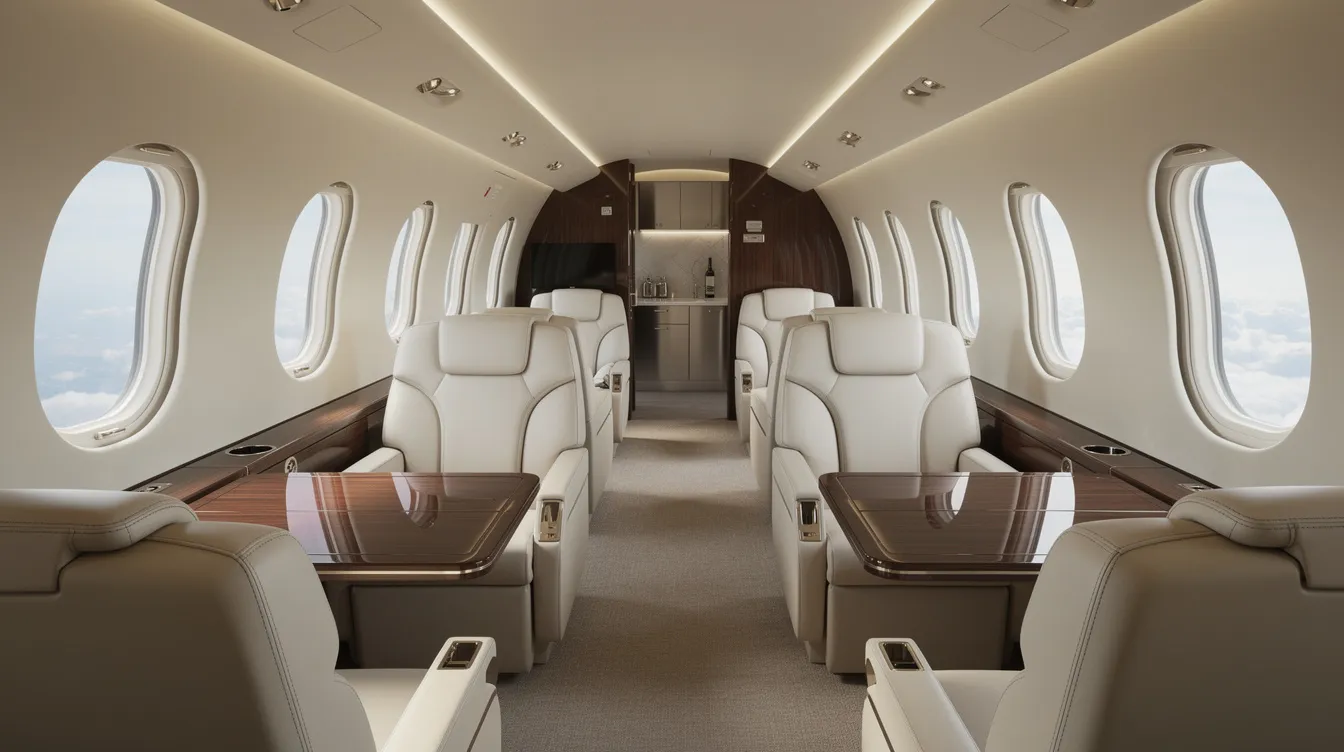
This comparison comes down to what matters most for a given trip: per-seat efficiency on a scheduled airline, or schedule and routing freedom on a private aircraft.
Boeing 777-200 flights have fixed schedules and shared cabins. That works well for solo travelers or small groups on high-volume routes, but it creates friction for tight business itineraries, complex multi-stop trips, or travel to secondary cities.
Here's how the two options compare on key factors:
|
Factor |
777-200ER (Commercial) |
Long-Range Private Jet Charter |
|---|---|---|
|
Schedule |
Fixed airline timetable |
Depart when ready |
|
Airport access |
Major hubs only |
Over 20,000 airports worldwide |
|
Check-in time |
2–3 hours before departure |
Arrive 15 minutes before departure |
|
Cabin |
Shared with 250–440 passengers |
Fully private for your group |
|
Routing |
Hub-to-hub, often indirect |
Direct point-to-point |
|
Range |
Up to ~7,725 nmi |
6,000–7,700+ nmi (depending on type) |
|
Nonstop flexibility |
Fixed routes |
Customized per mission |
Long-range private jets in Jettly's marketplace—such as the Dassault Falcon 8X, Gulfstream G650ER, and Bombardier Global 7500—offer 6,000–7,700+ nmi ranges, rivaling or matching many 777-200ER routes for smaller groups. Private jets offer flexible scheduling and direct routing that eliminate the layovers and backtracking common in hub-based airline networks.
Private flights eliminate long security lines and boarding waits. Private jet charters provide greater privacy than commercial flights, and private jets offer direct routing to over 20,000 airports—most of which no scheduled 777-200ER service touches—including regional gateways such as those served by private jet charter in Kolkata.
A practical use case: a 10-person executive team needs to fly direct between two secondary cities that lack nonstop 777-200ER service. Commercially, they face connections, overnight layovers, and 20+ hours of door-to-door travel. A long-range charter cuts that to a single nonstop flight with departure timed to their schedule. Private jets provide fully private cabins for passengers throughout.
For more on how to evaluate charter vs. commercial for specific trips, Jettly's aircraft charter guide walks through the key decision points and outlines how to select from its global fleet of private charter aircraft.
Range capability influences cost, but the commercial vs. private decision usually hinges on group size, schedule needs, and cabin expectations rather than raw distance alone.
Premium cabins on 777-200ER flights (Business or First) can run $5,000–$15,000+ per person on ultra-long-haul sectors, especially at short notice. For a group of 8–14 travelers, those costs add up quickly.
For groups of 6–14 travelers, chartering a long-range jet via Jettly or using a jet card flight cost estimator can sometimes approach the combined cost of multiple business-class tickets while adding privacy, time savings, and routing flexibility.
Jettly's charter cost estimator and its focus on affordable private jet charter let travelers compare estimated costs for real routes without commitment. This is the fastest way to see whether commercial or charter makes financial sense for a specific trip.
Jettly operates as a charter broker, with flights provided by certified third-party carriers operating under appropriate commercial regulations and optional jet card programs for frequent flyers. This transparency means travelers know exactly what they're booking and who is operating the flight.
Last-minute travel deserves special mention. Published fares on 777-200ER flights can spike dramatically close to departure, while charter pricing is based on aircraft availability and distance rather than demand-driven fare buckets. Some travelers can accommodate smaller aircraft on shorter notice for better economics.
One of Jettly's core strengths is helping travelers quickly identify aircraft with sufficient range for their specific itinerary—without needing to understand payload-range charts or ETOPS rules.
The platform provides access to a global inventory of more than 20,000 unique aircraft, from light jets and turboprops to ultra-long-range heavy jets. Jettly offers access to over 20,000 unique aircraft, making it straightforward to find options that match passenger count, route distance, and runway requirements.
Trip planners on the platform consider great-circle distance, seasonal winds, payload, and airport performance to recommend aircraft that can fly nonstop or with minimal fuel stops.
Jettly's private jet memberships and on-demand models offer predictable pricing and flexibility for frequent flyers who often travel on sectors similar in length to 777-200ER routes. Whether the need is a one-off intercontinental trip or a recurring schedule, the platform adapts.
Travelers interested in the best private jets for business travel can browse Jettly's curated categories or review the best private plane manufacturers to understand which aircraft types fit their typical mission profiles.
Many real-world trips are multi-leg—New York to Dubai to Mumbai, or London to São Paulo to Buenos Aires. Raw aircraft range is only one piece of the planning puzzle.
Commercial 777-200ER networks are hub-centric. A traveler flying from a secondary US city to a secondary Asian city may face two or three connections, overnight layovers, and backtracking through hubs, even though the total distance is well within a 777-200ER's range.
Private charter through Jettly can chain multiple sectors in a logical geographic order, using long-range jets to minimize overall travel time even if each leg is shorter than the aircraft's maximum range, whether via shared charter options or full charters explained in its guide to shared charter flights vs. full charters.
Factors like crew duty limits, ground handling availability, and overflight permits influence whether a trip is flown nonstop or broken into optimized segments. Existing aircraft in the charter market are paired with experienced crews who manage these logistics.
An example: a corporate team traveling New York–Riyadh–Mumbai on commercial flights faces 30+ hours of door-to-door travel, including connections. A long-range charter covers the same cities in two direct legs, with departure times chosen by the travelers. The search charter flights tool on Jettly and its guide to the ultimate list of charter airlines make it simple to explore multi-leg options.
Long-range flights—whether by 777-200ER or private jet—involve substantial fuel burn and environmental impact. This deserves honest acknowledgment rather than hand-waving.
Large twins like the 777-200ER were originally introduced to replace less efficient four-engine aircraft, improving seat fuel efficiency on long sectors. The 777's twin-engine design delivered a meaningful per-passenger emissions reduction compared to the 747s and other quad jet aircraft it replaced.
Newer models like the 787 and A350 further lower emissions per passenger-kilometer, although overall flight distance remains a key driver of total fuel burn.
Some charter customers consider carbon offset programs, shared charter flights, or efficient trip planning—avoiding unnecessary repositioning flights, consolidating group travel—to mitigate environmental impact when using long-range private jets. Jettly's empty leg flights can also help reduce waste by filling aircraft that would otherwise fly empty.
Practical decision-making helps: choose right-sized aircraft, minimize empty repositioning where possible, and consider combined travel for groups instead of booking multiple separate commercial tickets.
Many 777-200ERs delivered from the late 1990s to mid-2000s are now approaching or passing the 25–30 year mark in service. The aircraft's future is shifting.
Airlines are gradually replacing 777-200ERs with more efficient types: the Boeing 787-9/10, Airbus A350 (among many Airbus airliners now in long-haul service), and eventually the 777X family. The previous Boeing model is being supplanted on the longest routes first.
Some 777-200ERs are being retired, sold to secondary operators, or undergoing Boeing-converted freighter programs for cargo duty. A production freighter model of the 777 family has also attracted interest. Nine aircraft and ten aircraft batches have been traded in various fleet transactions in recent years.
Even as front-line passenger duty declines, the aircraft's range profile remains attractive for cargo and charter applications. The 777-200ER's payload-range capability makes it a viable passenger airliner for large-group charters, sports team travel, and VIP configurations.
Jettly can source widebody charter options—including Boeing 777-200 LR variants in VIP or ACMI-style setups—through certified operators for large groups, corporate events, or government missions.

The following questions address common reader concerns not fully covered above, focusing on practical travel decisions and approximate figures rather than deep technical data.
While the published maximum is around 7,725 nmi, a fully loaded aircraft on a commercial schedule typically plans routes in the 6,000–7,200 nmi band to allow for fuel reserves, alternate airports, and weather margins.
Routes like London–Tokyo (~5,950 nmi) or New York–Johannesburg (~6,900 nmi) are well within the 777-200ER's capabilities with full payload.
Airlines may limit cargo on the very longest routes to keep them reliably nonstop, particularly in winter when jet-stream headwinds strengthen.
Exact range on any specific day depends on temperature, wind, runway length, and regulatory requirements—each modeled in detail by dispatch teams before every departure.
Prevailing winds, especially high-altitude jet streams, often make eastbound flights shorter and more fuel-efficient than westbound flights on the same city pair.
A route comfortably within range eastbound may approach range limits westbound during certain seasons, requiring more fuel and potentially payload adjustments.
North Atlantic flight times can differ by over an hour between directions. A London–New York westbound crossing may take 8+ hours while eastbound can be under 7 hours.
Both private jet operators and airline dispatchers plan routing and departure timing to mitigate headwinds when possible, preserving range margins.
Long-range planning always includes diversion options. The 777-200ER operates under ETOPS rules that ensure suitable alternate airports are available within a defined time radius at all points along the route.
Fuel planning includes contingency fuel and alternate fuel, so the aircraft can divert safely for weather, medical issues, or technical concerns.
The need to maintain diversion options is one reason airlines rarely plan flights right at the theoretical maximum still-air range.
On private charters arranged via Jettly, flight planning follows similar safety margins set by the operating carrier's approvals and applicable regulations.
Leading private jets like the Gulfstream G650ER (~7,500 nmi) and Bombardier Global 7500 (~7,700 nmi) offer ranges directly comparable to many 777-200ER missions. Guides to the best private jet charter companies and the best Gulfstream jets now include the G700 (~7,750 nmi) and G800 (~8,200 nmi), which push even beyond airliner territory.
While a 777-200ER carries hundreds of passengers, long-range private jets are optimized for small groups (often 8–16) with high comfort and nonstop capability on very long sectors.
Private jets access smaller airports and offer flexible departure times, reducing total trip time even when nominal flight distance is the same.
Travelers can explore Jettly's aircraft categories to see which long-range options fit their party size and destination profile.
Key scenarios include tight business schedules, multi-city tours, late-night departures, and travel from or to airports without nonstop 777-200ER service.
Families or executive teams who would otherwise buy several long-haul business-class tickets may find charter cost-competitive while gaining privacy and direct routing; comparisons of jet rentals vs. first-class tickets can clarify the trade-offs for corporate travel.
Last-minute travel is another trigger. Published fares on 777-200ER flights can spike dramatically close to departure, making an on-demand charter worth serious consideration.
Running side-by-side comparisons using Jettly's instant-quote tools and its analysis of how much a private jet costs is the fastest way to decide which option best balances time, privacy, and budget for a specific trip.
The Boeing 777-200ER's range of roughly 7,725 nmi made it a cornerstone of global long-haul networks for British Airways, United Airlines, American Airlines, Pakistan International Airlines, and many other carriers. It reshaped what twin-engine airliners could accomplish and opened nonstop routes that simply didn't exist before.
Real-world usable range depends on payload, weather, and routing. Travelers should view brochure figures as upper bounds, not everyday norms. Understanding how range works helps evaluate whether a nonstop 777-200ER flight, a connection on newer widebodies, or a private long-range jet charter will best meet a given trip's needs.
For travelers who value time, privacy, and routing flexibility—especially in groups of 6 or more—private charter can match the 777-200ER's range while eliminating the friction of hub airports, fixed schedules, and shared cabins.
Ready to see how private charter compares for your next long-haul trip? Explore flight options, compare aircraft ranges, and request instant quotes through Jettly at https://www.jettly.com.
Share this post:
Jay Franco Serevilla
Nov 18, 2026
|
5
min read
Discover tips and trends in the industry.
5
min read
How Much Does a Pilot Make a Year? (2027 Guide to Airline Pilot Salaries)
In 2027, airline pilot salaries range from approximately $85,000 for entry-level regional pilots to over $450,000 for senior captains at major airlines. Factors such as rank, aircraft type, and employer significantly influence earnings, with additional compensation often including bonuses and profit sharing. This guide provides a comprehensive breakdown of pilot salaries, pay structures, and career progression.
Read More
5
min read
Fuel for Jet Engine: Types, Specifications, and What Matters for Private Jet Travel
Choosing the right jet fuel is crucial for private jet travel, impacting range, cost, and safety. This guide explains the main types of jet fuel, their specifications, and how they influence charter flights. Understanding these factors helps travelers make informed decisions when booking through platforms like Jettly.
Read MoreStay updated with our latest insights and tips to elevate your journey with us.
MEMBERSHIPS AND ASSOCIATIONS



© 2026 Jettly Inc. All rights reserved.
Disclaimer: Jettly operates as a charter broker, offering access to a global digital jet charter marketplace. Jettly is not a direct air carrier and does not own or operate aircraft. All advertised flights are conducted by third-party air carriers that are fully licensed and hold the appropriate Part 135 or Part 121 certifications issued by the Federal Aviation Administration (FAA) or equivalent regulatory authorities under U.S. or foreign law. Jettly complies fully with the U.S. Department of Transportation's Part 295 and Part 298 Charter Broker regulations. Jettly does not carry additional liability insurance. Passengers are covered by aircraft operator insurance. TICO: 50023770


