



Login
Get Instant Pricing On 23,000+ Aircraft

>

The term "flight for life insurance" blends several distinct financial protections: health insurance that covers emergency air medical transport, supplemental membership programs from providers like Life Flight Network, and the option to book private charter flights for planned medical travel through platforms like Jettly.
Flight for Life coverage is not traditional life insurance but an emergency transport service that helps offset air ambulance bills, which can run $25,000 to $60,000 per flight.
Life Flight Network offers memberships from $85 annually that can reduce or eliminate out-of-pocket expenses after medically necessary flights, but no membership guarantees aircraft dispatch.
Dedicated air medical memberships cover the primary member, spouse or domestic partner, and their entire household, though membership terms, waiting periods, and service area limits apply.
For non-emergency medical transport, families and case managers can use Jettly's instant-quote system to book fixed-wing aircraft or other private charters with full control over schedule, aircraft type, and routing.
In any life-threatening emergency, calling 911 remains the priority; Jettly serves planned or semi-urgent medical travel where timing and privacy matter.
Flight for Life coverage helps with emergency transport costs, while traditional life insurance supports beneficiaries after death. These are fundamentally different products. Flight insurance is a short-term policy for accidental death during flights; its duration is typically only for the specific flight or trip booked, it requires no medical exam or underwriting process, and it costs only a few dollars per trip. Flight insurance pays out for severe injury or death as a passenger on a licensed aircraft.
Traditional life insurance payouts cover any cause of death, unlike flight insurance. Not all flight insurance policies are regulated the same as traditional life insurance. Accidental death and dismemberment policies specifically cover catastrophic transit accidents but do not address the cost of emergency air medical transport itself.
In practice, "flight for life insurance" is shorthand for three layers: robust health insurance, regional air medical memberships that handle balance billing from helicopter or fixed-wing transports, and knowing when a private air transport solution through a broker like Jettly fits better than a 911-activated helicopter.
Air medical transport uses helicopters for rapid response scene flights and fixed-wing aircraft for longer-distance inter-facility transfers. Critical care transport teams provide mobile ICU-level support: ventilators, cardiac monitoring, blood products, and coordination with receiving hospitals.
Flight for Life has provided air ambulance services since 1972, completing over 150,000 flights in that time. Life Flight Network, founded in 1978, serves Oregon, Washington, Idaho, Montana, and Hawaii with rotor-wing, fixed-wing, and critical care ground ambulances operated 24/7, contributing to the broader ecosystem of charter airlines and private flights. Life Flight memberships cover emergency air-ambulance medical transport, and membership covers medically necessary flights for family members across the entire household.
Several regional programs exist beyond Life Flight Network:
|
Program |
Annual Cost |
Coverage Area |
Notable Detail |
|---|---|---|---|
|
$85/year (air-only); $1,500 lifetime |
OR, WA, ID, MT, HI |
Reciprocity with partner networks |
|
Program |
Annual Cost |
Coverage Area |
Notable Detail |
|---|---|---|---|
|
LifeFlight Eagle |
$59/year |
Missouri and Kansas |
CAMTS accredited since 2001; operates four helicopters |
|
Program |
Annual Cost |
Coverage Area |
Notable Detail |
|---|---|---|---|
|
Air St. Luke's |
$65/year |
114,000+ square miles |
Completed over 8,000 transports in 2025, including over 1,850 air transports |
Air transport costs can exceed $65 per year for membership, a fraction of a single transport bill. Life Flight Network offers air coverage memberships starting at $85, with a lifetime membership for $1,500. LifeFlight Eagle membership costs $59 annually for air transport coverage. These programs do not replace health insurance and do not guarantee dispatch; physicians and EMS dispatchers decide based on medical necessity, weather conditions, and safety.
Emergency air medical transport can cost between $25,000 and $60,000 per flight. Median U.S. charges reach roughly $36,400 for helicopter flights and $40,600 for fixed-wing, according to industry billing data. Insurance coverage depends on network status, medical necessity determinations, and plan details like deductibles and coinsurance.
Flight for Life programs may waive eligible transportation costs after health insurance billing, eliminating out-of-pocket expenses for members who use a participating provider. Without a membership, patients risk balance bills of $10,000 to $30,000 even after insurance pays its portion.
For those in aviation-related professions, standard life insurance can penalize high-risk jobs by applying exclusion riders on aviation-related risks. Aviation exclusion riders in life insurance can result in denial of claims for flight-related deaths. Specialized insurers may charge flat extra premiums for high-risk aviation policies instead of exclusions.
Underwriters evaluate specific aviation-related activities when determining insurance premiums, so comparing multiple insurers is essential when obtaining life insurance for high-risk professions. Specialized flight life insurance can provide guaranteed family protection regardless of incident location.
Non-emergency medical charter costs booked through Jettly are paid out of pocket but come with transparent, upfront pricing through tools like Jettly's jet card flight cost estimator and no surprise billing after the flight.
Emergency flight for life situations include trauma from a car crash in rural Montana, a stroke in a remote Idaho community needing time-sensitive transfer, or avalanche rescue where EMS triggers air medical rapid response. Ground ambulances and local hospitals connect patients to these medical transport systems, just as specialty providers and brokers connect travelers to top private jet charter companies for non-emergency transport.
Non-emergency scenarios that fit private medical charter:
A recovering cardiac patient in Phoenix needing a same-day transfer to a specialist in Seattle via private jet charter in Atlanta or other hubs
A mobility-limited traveler requiring a low-stress cabin from New York to Miami using private jet charter services in Houston or similar markets
A patient discharged from a European clinic who must fly home with nurse accompaniment, similar to travelers using private jet charter in Kolkata, West Bengal for complex itineraries.
Air medical programs serve critical care emergencies. Jettly focuses on chartering certified third-party aircraft for customized travel, including medical escort or stretcher setups, positioning itself as a flexible NetJets alternative for private flying. Patients and families should always call emergency services first in life-threatening situations and consider Jettly only for planned medical travel.
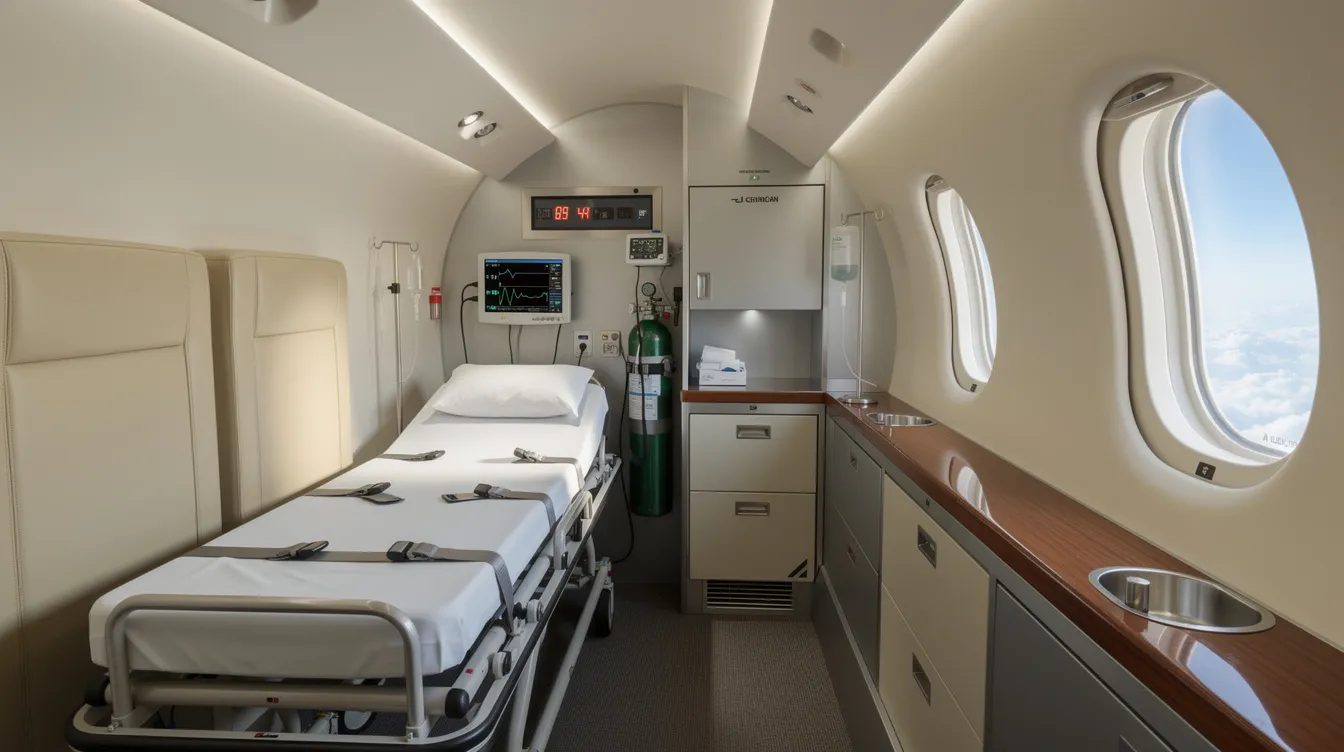
Jettly is a digital private jet charter broker offering flexible private jet memberships and connecting users to over 20,000 aircraft worldwide. The platform does not provide air medical transport or critical care transport itself; flights are operated by third-party carriers under FAA Part 135 or equivalent certification, and onboard medical support is arranged through specialized partners.
Practical advantages for medical-related travel include departure from smaller airports closer to home or hospital, direct routing without layovers, tailored cabin layouts for stretcher clearance, and room for family or caregivers, all of which align with modern options for getting a seat on a private jet. Jettly's private jet charter cost estimator lets case managers compare aircraft classes and choose the right airplane for a patient's needs in minutes rather than days.
For example, booking a turboprop from Boise to Portland for a recovering patient who cannot tolerate commercial connections takes a single search on Jettly's private charter aircraft platform. The result: financial peace through predictable costs, and peace of mind through a controlled travel environment.
Managing flight for life risks requires three pillars: strong health insurance, regional air medical memberships (Life Flight Network, LifeFlight Eagle, Air St. Luke's), and private charter access through Jettly for non-emergency medical travel.
Action checklist:
Review your health insurance policy for air transport clauses and out-of-pocket maximums
Check availability of air medical memberships in your surrounding region; note the 72-hour waiting period after a completed application.
For recurring medical travel, use Jettly's airport locator tool to compare aircraft types and costs in real time.e
Ready to explore private air transport for medical or recovery travel? Review affordable private jet charter options and request an instant quote at https://www.jettly.com.
Answers below address common questions not fully covered in the main article. Always check your own policy and membership documents for exact details, as coverage and membership terms vary by region.
No. A Life Flight Network membership is supplemental protection that helps reduce or eliminate out-of-pocket costs for medically necessary emergent transports performed by Life Flight Network. It does not replace comprehensive health insurance. Your insurance company still plays the primary role in covering hospital care, physician services, and transport charges. The membership focuses on limiting balance bills from eligible air or ground transports after insurance has been billed.
No membership or insurance product can guarantee dispatch. Decisions to launch air medical aircraft are made by physicians, EMS dispatchers, and medical control based on clinical need, safety, weather conditions, and resource availability. Providers will not dispatch solely because someone holds a membership card.
Jettly is not an emergency response service and should not replace 911 or dedicated air ambulance providers for life-threatening conditions. Jettly charters support planned or semi-urgent transfers once a patient is stable and cleared to fly by a physician.
Coverage for non-emergency private charter flights depends on the traveler's health insurance, travel insurance, or corporate risk policies. Many such flights are paid out of pocket. Speak with your insurer or benefits administrator before booking if reimbursement matters, and keep all invoices and medical documentation.
Obtain written medical clearance to fly, confirm whether a nurse or paramedic is required on board, coordinate ground ambulances or wheelchair-accessible vehicles at both ends, and consider arranging in-flight catering for private jets if comfort and nutrition are priorities on longer trips.
Share equipment dimensions with the Jettly team to match an appropriate aircraft, and when budgets are tight, explore options to crowdsource private jet flights and share empty seats where medically appropriate. Bring copies of medical records, medication lists, and emergency contact information. Arrange any required oxygen or specialized equipment through approved providers rather than carrying it independently without prior authorization.
Flight for life insurance can refer to different protections, so compare health insurance, short-term flight insurance, and regional air medical memberships before relying on any one option. Membership benefits, service areas, eligibility rules, and payment terms vary by provider.
Review Life Flight Network membership details, LifeFlight Eagle’s membership terms, and Air St. Luke’s coverage information to confirm how each program may assist permanent residents in your household. These programs support emergency medical transport, while Jettly helps arrange planned, non-emergency medical travel through a broad range of charter aircraft.
For emergencies, call 911. For stable patients who need a coordinated trip, Jettly can help compare aircraft and routing options. Learn more about medical charter flights and Jettly membership options. Explore Jettly’s charter options at https://www.jettly.com.
Share this post:
Jay Franco Serevilla
Nov 18, 2026
|
5
min read
Discover tips and trends in the industry.

5
min read
What Is the Best Fighter Plane in the World?
The best fighter plane in the world is often debated, with the F-22 Raptor frequently cited for its air superiority capabilities. However, the F-35 Lightning II excels in multirole operations, while emerging contenders like the J-20 and Su-57 showcase advanced technologies. Ultimately, the 'best' fighter depends on mission requirements and operational context.
Read More
5
min read
How Fast Is Mach 10 Speed? (Top Gun: Maverick, Hypersonic Flight & Reality)
Mach 10 speed, approximately 7,670–7,826 mph, is firmly in the hypersonic realm, far beyond any crewed aircraft capabilities. While films like Top Gun: Maverick depict thrilling Mach 10 flights, no human has ever flown at this speed, with the current record being Mach 6.7. Real-world aviation prioritizes safety and efficiency over extreme speeds, focusing on practical travel solutions.
Read MoreStay updated with our latest insights and tips to elevate your journey with us.
MEMBERSHIPS AND ASSOCIATIONS



© 2026 Jettly Inc. All rights reserved.
Disclaimer: Jettly operates as a charter broker, offering access to a global digital jet charter marketplace. Jettly is not a direct air carrier and does not own or operate aircraft. All advertised flights are conducted by third-party air carriers that are fully licensed and hold the appropriate Part 135 or Part 121 certifications issued by the Federal Aviation Administration (FAA) or equivalent regulatory authorities under U.S. or foreign law. Jettly complies fully with the U.S. Department of Transportation's Part 295 and Part 298 Charter Broker regulations. Jettly does not carry additional liability insurance. Passengers are covered by aircraft operator insurance. TICO: 50023770


